
SLAP Lesion Repair: Why Is It Needed & How Is It Performed?
Understand SLAP tears, available treatment options, arthroscopic repair, and the journey toward recovering shoulder strength and function.
Is persistent shoulder pain stopping you from lifting weights, playing your favourite sport, or reaching overhead comfortably? A SLAP lesion could be one possible reason.
Your shoulder allows you to throw a ball, lift objects, reach behind your back, and perform countless everyday activities. However, this flexibility depends heavily on soft tissues that help keep the joint stable.
One important structure is the labrum, a ring of cartilage surrounding the shoulder socket. When its upper portion tears, the injury is known as a SLAP lesion.
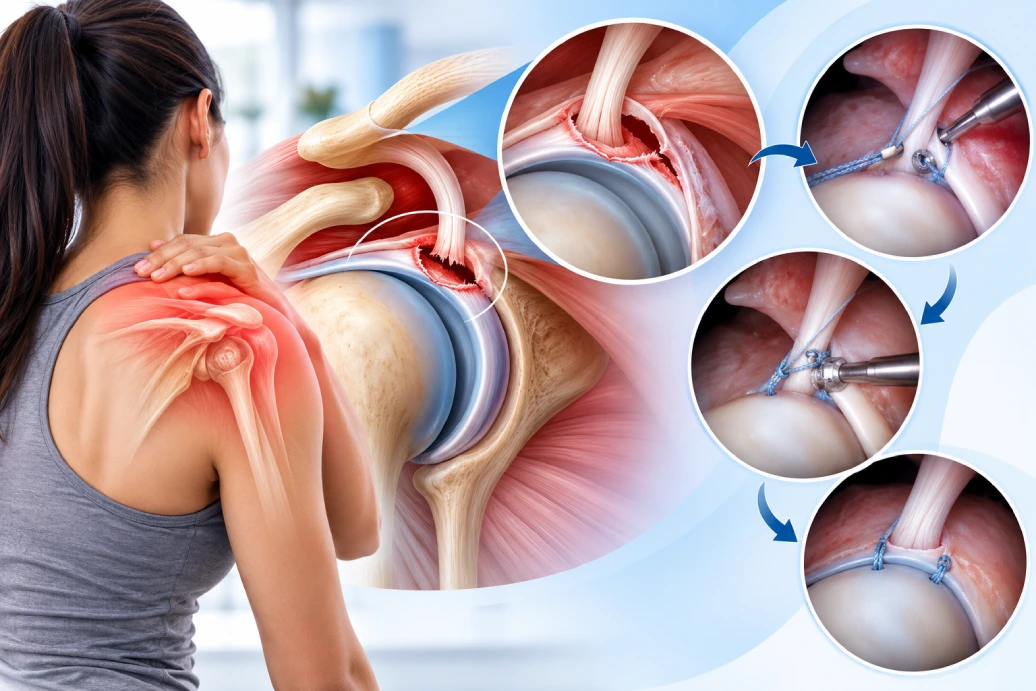
What Is a SLAP Lesion?
SLAP stands for Superior Labrum Anterior to Posterior. It describes a tear in the upper portion of the shoulder's labrum, extending from the front toward the back of the socket.
The long head of the biceps tendon attaches near this region. Consequently, certain SLAP injuries can cause pain during lifting, pulling, and overhead movements.
Imagine the labrum as a protective rim that helps hold a ball securely in a shallow cup. When part of that rim becomes damaged, shoulder movement may become painful or less comfortable.
No. Many patients improve with physiotherapy, activity modification, and appropriate pain management. Surgery is considered when symptoms persist despite suitable nonsurgical treatment.
What Causes a SLAP Tear?
SLAP lesions may develop suddenly following an injury or gradually because of repeated shoulder stress and age-related changes.
Sudden Injury
A fall onto an outstretched hand, an unexpected heavy lift, or a traumatic shoulder injury can damage the upper labrum.
Repetitive Overhead Activity
Repeated throwing, swimming, tennis, volleyball, and other overhead activities may place stress on the labrum and surrounding structures.
Shoulder Dislocation
Traumatic shoulder injuries or dislocations can be associated with damage to the labrum and other stabilizing tissues.
Age-Related Changes
The labrum may undergo wear and degeneration over time, particularly in people with longstanding shoulder stress.
Athletes who repeatedly throw, lift overhead, or perform demanding shoulder movements may be particularly susceptible to SLAP lesions.
How Do You Know If You Have a SLAP Lesion?
A SLAP lesion may cause pain deep inside the shoulder joint, particularly when lifting the arm or performing overhead activities.
Common Symptoms
- Deep shoulder pain.
- Clicking or catching sensations.
- Shoulder weakness.
- Reduced sporting performance.
- Discomfort while lifting or carrying objects.
- A feeling of shoulder instability.
How Is It Diagnosed?
An orthopedic specialist may assess your shoulder using a physical examination and appropriate clinical tests.
MRI or MR arthrography may be recommended to investigate a suspected labral injury.
Imaging findings must be interpreted alongside symptoms, because labral abnormalities can sometimes occur in people without shoulder pain.
Rotator cuff injuries, biceps tendon problems, and other shoulder conditions can produce similar symptoms. Identifying the actual source of pain helps guide the treatment plan.
Why Is SLAP Lesion Repair Needed?
Many patients improve without surgery. Physiotherapy, modification of aggravating activities, and appropriate pain relief are often the first steps in treatment.
Nonsurgical Treatment
A structured rehabilitation programme may help restore shoulder strength, mobility, and function. The programme often lasts three to six months, depending on the individual.
When Surgery May Be Considered
Surgery may be an option when persistent symptoms interfere with daily activities or sporting performance despite adequate nonsurgical treatment.
What Factors Influence the Decision?
- The patient's age and activity level.
- The type and stability of the labral tear.
- Whether the biceps tendon is involved.
- Sporting and occupational demands.
- The response to physiotherapy and other treatments.
Your surgeon may consider SLAP repair when an unstable tear is suitable for repair, particularly in an active younger patient. The most appropriate treatment depends on your individual assessment.
How Is SLAP Lesion Repair Performed?
Most surgical SLAP repairs are performed using shoulder arthroscopy. This minimally invasive technique uses a small camera and specialized instruments introduced through small incisions.
Anaesthesia and Preparation
The procedure is commonly performed under general anaesthesia, often combined with a regional nerve block to help control postoperative pain.
Identifying the Tear
The surgeon introduces an arthroscope through a small incision to examine the labrum, biceps attachment, cartilage, and surrounding structures.
Repairing the Labrum
If repair is appropriate, the surgeon prepares the attachment area and uses small suture anchors to secure the torn labrum back to the shoulder socket.
Protecting the Repair
The incisions are closed and dressings are applied. The arm is supported in a sling while the repaired tissues begin to heal.
When SLAP repair is appropriate, the goal is to reattach the torn labrum securely and help restore shoulder function. Rehabilitation protects the repair while strength and mobility are gradually regained.
Is SLAP Repair Always the Best Surgical Option?
Not necessarily. The appropriate procedure depends on the type of tear, the condition of the labrum and biceps tendon, the patient's age, and individual activity requirements.
SLAP Repair
The surgeon reattaches the torn labrum to the shoulder socket using sutures and small anchors.
This may be considered for selected unstable tears that are suitable for repair.
Debridement
Unstable or frayed tissue is removed or smoothed without reattaching the labrum.
This may be appropriate for selected labral abnormalities that do not require structural repair.
Biceps Tenodesis
The long head of the biceps tendon is detached from its original attachment and reattached to the upper arm bone.
This can reduce stress on a damaged biceps attachment in appropriately selected patients.
It may be preferable for selected patients when the biceps tendon is a significant source of pain or the labrum has degenerative changes. Your surgeon will explain which option best suits your condition.
Pain Management After SLAP Lesion Repair
Some discomfort, swelling, and stiffness are expected after surgery, especially during the first few days. Your surgical team will recommend an appropriate pain-management plan.
Medication
Your surgeon may recommend paracetamol, suitable anti-inflammatory medication, or short-term stronger pain relief when necessary.
Cold Therapy
A wrapped ice pack applied for 15–20 minutes at a time may help reduce discomfort and swelling. Follow your surgical team's instructions.
Sling Support
Wearing the prescribed sling protects the repair and helps prevent movements that could place excessive strain on healing tissues.
Comfortable Sleeping
Sleeping slightly upright with pillows supporting the operated arm may make the initial recovery period more comfortable.
Guided Physiotherapy
Gentle exercises introduced at the appropriate stage help reduce stiffness without placing unnecessary strain on the repair.
Contact your surgical team promptly if you develop fever, increasing wound redness, drainage, or pain that worsens rather than improves.
Sudden chest pain or breathlessness requires emergency medical assessment.
SLAP Repair Recovery: When Can You Return to Normal Activities?
Recovery is gradual because the repaired labrum needs time to heal securely. Your rehabilitation programme will progress according to the procedure performed and your surgeon's protocol.
Protection and Early Healing
A sling is commonly worn for two to six weeks. Gentle, therapist-guided movements may begin according to the surgeon's instructions.
Avoid unsupported lifting, pulling, or sudden shoulder movements.
Restoring Shoulder Mobility
Shoulder movement gradually increases. Physiotherapy focuses on improving flexibility and introducing appropriate strengthening exercises.
Building Functional Strength
Strength, endurance, and movement control become priorities. Some patients begin carefully supervised sport-specific exercises.
Returning to Activity
Many patients progress toward more demanding activities. Throwing athletes and people involved in contact sports may need a longer rehabilitation period before unrestricted participation.
These timeframes are general estimates, not fixed milestones. Recovery depends on the procedure, associated injuries, and individual healing.
Feeling better does not necessarily mean the repaired tissue is ready for heavy lifting or competitive sport. Clearance should be based on strength, movement, functional testing, and your surgeon's assessment.
What Are the Expected Outcomes of SLAP Lesion Repair?
For appropriately selected patients, surgery can reduce pain, improve shoulder function, and support a return to daily activities or sports.
Reduced Pain
Treatment aims to reduce symptoms associated with the injured labrum and improve comfort during movement.
Improved Function
Appropriate treatment and rehabilitation can help improve shoulder movement and everyday function.
Return to Sport
Many patients progress toward sporting activities following rehabilitation, although outcomes vary between individuals.
Individual Recovery
The severity of the tear, age, associated injuries, chosen procedure, and rehabilitation adherence can all influence recovery.
What Does Research Say About Returning to Sport?
The supplied article reports that a 2024 systematic review and meta-analysis found approximately 91% of patients returned to sport after surgical treatment for SLAP lesions, while approximately 72% returned to their previous performance level.
These figures included different surgical techniques and patient groups. They should not be interpreted as a guaranteed outcome for an individual patient.
What Are the Possible Complications?
Although outcomes can be favorable, possible complications associated with surgery include:
- Persistent shoulder pain.
- Shoulder stiffness.
- Infection.
- Nerve injury.
- Failure of the repair.
Discussing the potential benefits, limitations, and risks with your orthopedic surgeon helps establish realistic expectations before treatment.
Frequently Asked Questions About SLAP Repair
1. Can a SLAP tear heal without surgery?
Symptoms can improve significantly with physiotherapy and activity modification, even if the structural tear remains visible on imaging. Surgery is not automatically necessary.
2. Is SLAP repair a major surgery?
SLAP repair is an orthopedic procedure commonly performed using shoulder arthroscopy. It involves repairing the labrum with sutures and small anchors when appropriate. Recovery requires a period of protection and structured rehabilitation.
3. When can I drive after SLAP repair?
The timing depends on your recovery, sling use, pain, mobility, and whether you are taking medication that affects alertness. Resume driving only when your surgeon confirms that it is safe and you can control the vehicle without restriction.
4. Can I return to the gym after SLAP repair?
Many patients return to gym activities gradually. Heavy lifting and overhead exercises should be avoided until your surgeon and physiotherapist approve them.
5. How long does recovery take?
Initial protection commonly lasts several weeks. Progressive mobility and strengthening follow, while demanding activities and sports may require four to six months or longer, depending on the procedure and individual recovery.
Don't Let Shoulder Pain Limit Your Life
A SLAP lesion can affect much more than athletic performance. Carrying groceries, reaching for a shelf, lifting objects, or sleeping comfortably may become difficult.
The key is identifying the actual cause of shoulder pain and choosing treatment based on your individual needs.
SLAP repair is not necessary for every tear. When surgery is appropriate, careful surgical treatment and structured rehabilitation can help restore shoulder comfort and function.
Expert Shoulder Arthroscopy & Sports Injury Care in Hyderabad
For evaluation and personalized treatment of SLAP lesions, shoulder instability, labral tears, rotator cuff injuries, and sports-related shoulder problems, consult Dr. Aditya Kapoor.
Get an individualized assessment to understand your treatment options and the next steps toward recovery.
Book Your ConsultationThis page provides general educational information and does not replace a professional medical assessment. Diagnosis, treatment, and rehabilitation should be individualized by your treating orthopedic specialist.
