
AC Joint Repair: Why Is It Needed & How Is It Performed?
From understanding shoulder injuries to surgical treatment and recovery, learn how AC joint repair may help restore shoulder stability and function.
Shoulder pain after a fall or sports injury? Noticed a bump on top of your shoulder or difficulty lifting your arm? An acromioclavicular (AC) joint injury may be to blame.
Your shoulders play an essential role in everyday activities, from getting dressed and carrying groceries to lifting weights and playing sports. A sudden fall, collision, or direct impact can damage one of the shoulder's important stabilizing joints.
While minor AC joint injuries often heal without surgery, severe injuries may require an operation to restore stability and shoulder function.
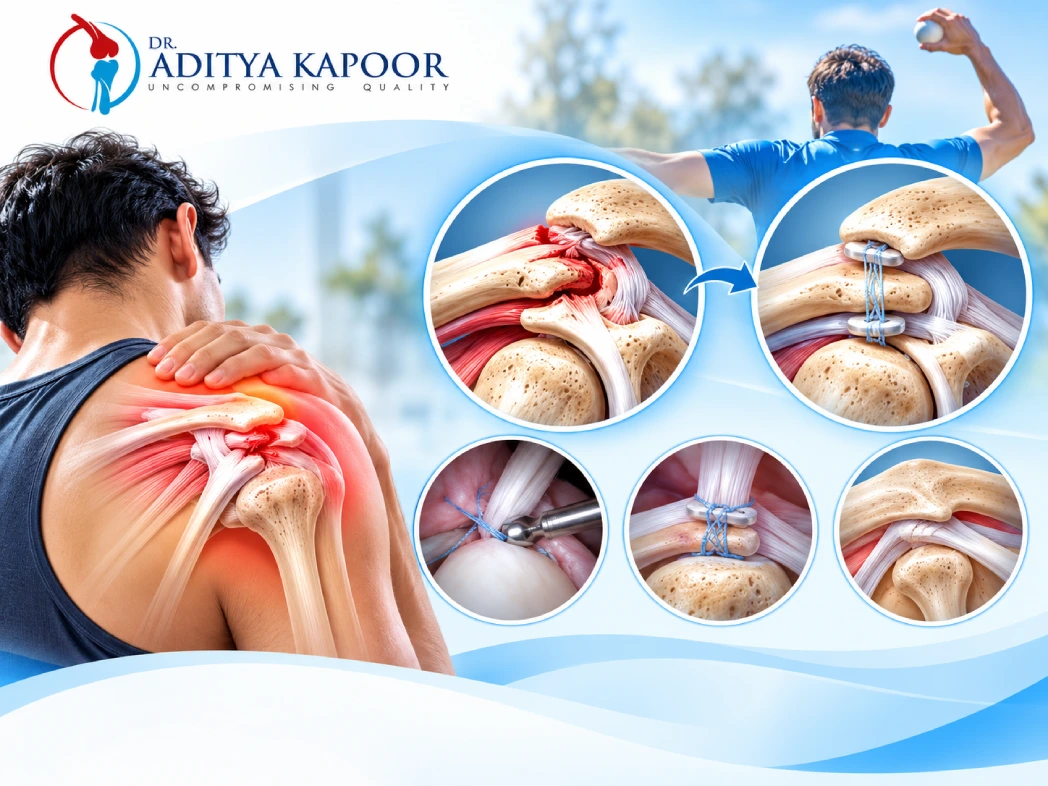
What You Should Know About AC Joint Repair
If you have injured your shoulder, you may wonder whether surgery is necessary, what the procedure involves, and how long recovery will take.
The answer depends on the severity of the injury, the extent of ligament damage, your symptoms, and your daily physical demands. Let's explore the causes, treatment options, surgical procedure, and recovery process.
What Is the AC Joint, and Why Is It Important?
The acromioclavicular (AC) joint is located at the top of your shoulder, where the collarbone (clavicle) meets a part of the shoulder blade called the acromion.
Although small, this joint plays an important role in coordinating shoulder movements. Strong ligaments help keep the joint stable.
Acromioclavicular Ligaments
These ligaments help stabilize the connection between the collarbone and the acromion.
Coracoclavicular Ligaments
These ligaments help maintain the position of the collarbone relative to the shoulder blade.
When the ligaments stretch or tear, the bones may move out of their normal alignment, resulting in an AC joint separation.
Unlike a shoulder dislocation, which involves the main ball-and-socket joint, an AC joint separation affects the connection at the top of the shoulder.
What Causes an AC Joint Injury?
A sudden force on the shoulder can damage the ligaments that hold the collarbone in position. This may happen during sports, an accident, or an everyday fall.
Common Causes
- Falling directly onto the shoulder.
- Road traffic or cycling accidents.
- Contact sports such as football, rugby, or wrestling.
- Sudden impact during athletic activities.
- Accidental falls at home or work.
Warning Signs
- Pain concentrated at the top of the shoulder.
- Swelling, tenderness, or bruising.
- A visible bump near the outer end of the collarbone.
- Difficulty lifting the arm overhead.
- Pain while reaching across the chest.
- A feeling of instability or weakness.
A visible bump does not automatically mean surgery is required. The severity of ligament damage, shoulder function, and individual needs help determine the most appropriate treatment.
Why Is AC Joint Repair Needed?
Does every AC joint separation require surgery? No. Many injuries can be treated without an operation, while more severe injuries may require surgical evaluation.
AC joint injuries are commonly classified using the Rockwood system, which categorizes injuries from Type I to Type VI.
Types I and II
Usually involve mild to moderate ligament injuries and are generally managed without surgery.
Type III
Involves complete disruption of important stabilizing ligaments. Treatment is individualized. Many patients recover without surgery, while selected patients may benefit from an operation.
Types IV, V, and VI
These injuries involve more severe displacement and generally warrant surgical evaluation.
The Goal of Treatment
Restore appropriate joint stability, reduce symptoms, and improve shoulder function rather than focusing only on the visible bump.
When Might Surgery Be Recommended?
Your orthopedic surgeon may recommend AC joint repair or reconstruction when:
- The injury causes significant joint displacement.
- Shoulder instability affects daily activities.
- Pain and functional limitations persist despite rehabilitation.
- The injury is severe or involves associated damage.
- High physical demands make persistent instability particularly problematic.
How Is AC Joint Repair Performed?
AC joint surgery may be performed using open, arthroscopic-assisted, or combined techniques. The exact procedure depends on whether the injury is recent or longstanding, the extent of ligament damage, and the surgeon's assessment.
Anaesthesia and Preparation
The procedure is usually performed under general anaesthesia, sometimes combined with a regional nerve block to provide postoperative pain relief. The surgeon positions the patient and prepares the shoulder using sterile techniques.
Assessing the Injury
Through a small incision or an arthroscopic-assisted approach, the surgeon evaluates the displaced collarbone and damaged supporting ligaments. Associated injuries may also be assessed when clinically indicated.
Restoring Joint Alignment
The surgeon carefully repositions the collarbone to improve its alignment with the shoulder blade. This restores the relationship between the bones and prepares the joint for stabilization.
Stabilizing or Reconstructing the Ligaments
Depending on the injury, the surgeon may use:
- High-strength sutures or suture-button fixation devices.
- Ligament repair techniques.
- Tendon grafts to reconstruct damaged ligaments.
- Other fixation methods when appropriate.
In longstanding injuries, ligament reconstruction using a tendon graft may be necessary because the original ligaments may no longer heal reliably.
Closure and Protection
After confirming stability, the surgeon closes and dresses the incisions. The arm is usually placed in a sling to protect the repair during early healing.
Many procedures take approximately one to two hours, although complex reconstructions may require longer.
Pain Management After AC Joint Repair
Some postoperative pain and swelling are normal, particularly during the first few days. Your surgeon will recommend suitable measures to make recovery more comfortable.
Medication
Your surgeon may prescribe paracetamol, appropriate anti-inflammatory medicines, or short-term stronger pain medication when needed. Take medicines exactly as directed.
Cold Therapy
Applying a wrapped ice pack for 15–20 minutes at a time can help reduce pain and swelling. Avoid placing ice directly on the skin.
Sling Support
A sling protects the healing ligaments and reduces unwanted shoulder movement. Do not discontinue it earlier than recommended.
Comfortable Sleeping
Sleeping in a slightly reclined position with pillows supporting the arm may help reduce nighttime discomfort.
Gentle Rehabilitation
Physiotherapy is introduced gradually according to your surgeon's protocol. Early exercises may focus on the hand, wrist, and elbow before shoulder movements are progressed.
Increasing redness, fever, wound drainage, worsening pain, or new numbness should prompt medical review.
AC Joint Repair Recovery: How Long Does Healing Take?
Recovery is a gradual process. Although pain may improve relatively quickly, repaired or reconstructed ligaments require considerably more time to heal.
Protection and Healing
The shoulder is commonly supported in a sling for approximately four to six weeks. Patients may perform approved hand, wrist, and elbow exercises.
Heavy lifting, pushing, pulling, and unsupported overhead movements are generally avoided.
Regaining Shoulder Mobility
Once sufficient healing has occurred, supervised physiotherapy focuses on gradually restoring shoulder movement. Gentle strengthening may begin when approved by the surgeon.
Building Strength and Stability
Exercises increasingly target the shoulder muscles, rotator cuff, and shoulder blade stabilizers. Patients gradually return to more demanding daily activities as strength and movement improve.
Returning to Sports
Many patients progress toward recreational sports and physically demanding activities during this period. Contact sports, heavy lifting, and competitive athletics may require six months or longer.
These timelines are general estimates. Your surgeon and physiotherapist will determine when specific activities are safe based on the procedure and your rehabilitation progress.
What Are the Expected Outcomes of AC Joint Repair?
For appropriately selected patients, AC joint repair or reconstruction can provide meaningful improvements in pain, stability, and shoulder function.
Many patients return to work, exercise, and sporting activities after completing rehabilitation.
Factors That Can Influence Recovery
Injury Severity
The severity and age of the injury can influence the treatment approach and healing process.
Surgical Technique
The selected technique depends on the nature of the injury and the surgeon's assessment.
Associated Injuries
Other shoulder damage may affect rehabilitation and functional recovery.
Rehabilitation Commitment
Following the prescribed physiotherapy program and activity restrictions is an important part of recovery.
Are There Any Possible Complications?
Like any surgical procedure, AC joint repair carries certain risks. These may include:
- Infection.
- Shoulder stiffness or persistent pain.
- Loss of correction.
- Implant irritation.
- Fracture.
- Recurrent instability.
Some patients may retain a visible bump even when shoulder function improves. Discussing the possible benefits and risks with your orthopedic surgeon helps establish realistic expectations.
Frequently Asked Questions About AC Joint Repair
1. Can an AC joint injury heal without surgery?
Yes. Many mild and moderate injuries, and some complete separations, respond well to nonsurgical treatment involving a sling, pain relief, and physiotherapy.
2. Is AC joint repair a major surgery?
It is a specialized orthopedic procedure that may be performed using minimally invasive or open techniques. Although many patients go home the same day, proper rehabilitation is essential.
3. Can I return to the gym after AC joint repair?
Most patients can gradually return to exercise. However, heavy pressing, overhead lifting, and contact activities should only resume after medical clearance.
4. Will the bump on my shoulder disappear after surgery?
Surgery aims to improve alignment, but a completely normal appearance cannot be guaranteed. Functional improvement is usually the more important treatment goal.
5. What happens if a severe AC joint injury is left untreated?
Some patients develop persistent pain, weakness, or instability. Others maintain good function despite visible deformity. The need for surgery depends on symptoms, injury severity, and functional demands.
When Should You Consult an Orthopedic Shoulder Specialist?
If you experience persistent pain, a noticeable shoulder deformity, difficulty lifting your arm, or reduced shoulder strength following an injury, an orthopedic assessment can help identify the problem.
Clinical examination and X-rays are commonly used to evaluate AC joint separation. Additional imaging may be recommended when associated injuries are suspected.
Early evaluation can help determine whether rehabilitation or surgical treatment is most appropriate.
Restore Shoulder Stability, Regain Your Confidence
An AC joint injury can interrupt your routine, affect sporting performance, and make everyday activities uncomfortable.
Many injuries recover with appropriate nonsurgical care. For selected severe or persistently symptomatic injuries, surgical repair or reconstruction may help restore stability and improve shoulder function.
Choosing the right treatment for the right patient and following a structured rehabilitation program are important parts of the recovery journey.
Expert AC Joint Repair & Shoulder Arthroscopy in Hyderabad
Are you struggling with shoulder pain, instability, or restricted movement after an injury?
Consult Dr. Aditya Kapoor — Orthopedic Surgeon, Joint Replacement, Arthroscopy & Sports Medicine Specialist in Hyderabad — for personalized evaluation and treatment of AC joint injuries, shoulder instability, ligament tears, and other sports-related shoulder conditions.
Book Your Consultation TodayMedical information on this page is intended for general educational purposes. Treatment decisions and rehabilitation schedules should be individualized by your treating orthopedic specialist.
