
Joint Injections for Tendinopathies: Procedure, Pain Management, Recovery, and Outcomes
Are persistent tendon pain, stiffness, or recurring sports injuries affecting your daily activities? Targeted injections may help manage certain tendon conditions and support rehabilitation in selected cases.
Shoulder pain while lifting your arm, elbow pain while gripping objects, or Achilles tendon discomfort during your first steps may be associated with tendinopathy.
Explore Treatment Options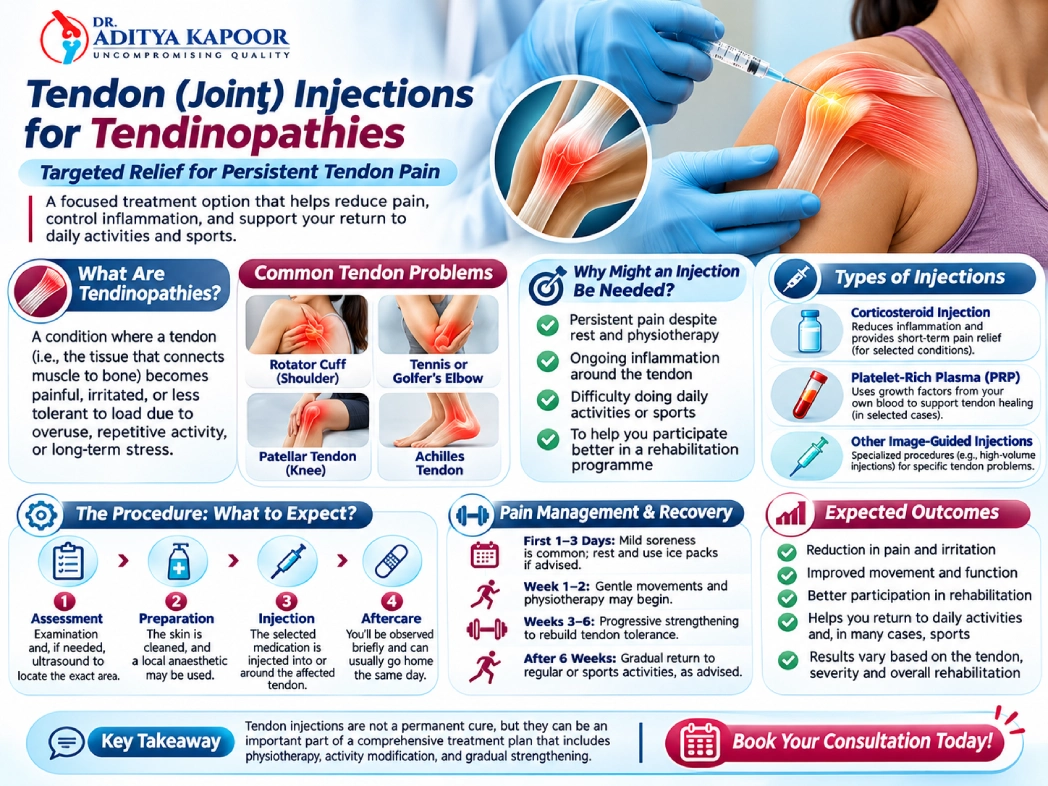
1. What Is Tendinopathy?
Tendons are strong, flexible structures that connect muscles to bones. They help transmit muscular force, allowing you to walk, run, jump, lift, and perform everyday movements.
When a tendon becomes painful or develops changes associated with excessive loading, the condition is often described as tendinopathy. It may involve changes in tendon structure, impaired load tolerance, and sometimes inflammation in surrounding tissues.
Rotator Cuff Tendinopathy
Shoulder pain during lifting or overhead activities.
Tennis Elbow
Pain around the outer elbow, commonly associated with repetitive gripping.
Golfer's Elbow
Pain around the inner elbow.
Patellar Tendinopathy
Pain below the kneecap, especially during jumping or running.
Achilles Tendinopathy
Pain and stiffness around the heel or lower calf.
Gluteal Tendinopathy
Pain on the outer side of the hip.
Although these conditions affect different body regions, they share one important characteristic: the tendon becomes less tolerant of certain physical loads.
2. Why Do Tendinopathies Develop?
Can tendon damage occur even without a major injury? Absolutely. Many tendon problems develop gradually rather than after a single accident.
Repetitive Movements
Repeated gripping, lifting, running, or jumping may overload a tendon.
Sudden Increases in Activity
Starting an intense workout programme or rapidly increasing training volume can place excessive stress on tendons.
Age-Related Tendon Changes
Tendons may become less adaptable to loading with age.
Poor Muscle Conditioning
Weakness or inadequate strength can contribute to excessive stress on specific tendons.
Biomechanical Factors
Movement patterns, joint mobility, and training technique may influence tendon loading.
Certain Medical Conditions
Diabetes, inflammatory disorders, and some metabolic conditions may increase the risk of tendon problems.
3. Warning Signs of Tendinopathy
A common pattern is pain that improves with rest but returns when exercise or repetitive activity resumes.
- Pain during specific movements.
- Localized tenderness near a tendon.
- Morning stiffness.
- Discomfort after exercise.
- Reduced strength or endurance.
- Difficulty gripping, lifting, running, or jumping.
- Pain that gradually interferes with daily activities.
Some patients also experience swelling or thickening around the affected tendon. Tendon tears, arthritis, nerve problems, and other conditions can produce similar symptoms, so accurate diagnosis is essential.
4. Why Are Injections Needed for Tendinopathies?
Does every painful tendon need an injection? No. Progressive exercise-based rehabilitation is usually the foundation of tendinopathy treatment.
Most patients should first receive an individualized programme involving load modification, strengthening exercises, and gradual return to activity.
When may injections be considered?
- Pain persists despite appropriate rehabilitation.
- Symptoms interfere significantly with everyday activities.
- Pain prevents participation in necessary strengthening exercises.
- A specific inflammatory condition around the tendon is present.
- A specialist identifies a suitable indication for an image-guided intervention.
5. What Types of Injections Are Used?
1. Corticosteroid Injections
Corticosteroids are medications that reduce inflammation. They may provide short-term pain relief in selected conditions, particularly when inflammation affects structures surrounding a tendon.
For example, injections into the subacromial bursa may sometimes be considered for rotator cuff-related shoulder pain.
Important limitation: Corticosteroids are not routinely recommended for every chronic tendinopathy. Repeated exposure may weaken tendon tissue, and injecting corticosteroids directly into a tendon can increase the risk of tendon damage or rupture.
2. Platelet-Rich Plasma (PRP) Injections
PRP is prepared using a sample of the patient's blood. The blood is processed to concentrate platelets, which contain biological factors involved in tissue responses.
The prepared PRP is injected into or around the affected tendon, depending on the condition and technique.
Some studies suggest benefits for selected chronic tendon disorders. However, research findings are inconsistent, and PRP has not been conclusively shown to provide reliable long-term benefits for every tendinopathy.
3. High-Volume Image-Guided Injections
These procedures involve injecting fluid around a tendon to target certain tissue interfaces. They have been investigated for conditions such as chronic Achilles or patellar tendinopathy.
Evidence remains limited, and they are not routine first-line treatments.
4. Other Injection-Based Treatments
Some specialists may consider procedures such as tendon fenestration or other biologically oriented interventions.
These techniques have different indications and evidence levels. The best treatment depends on the affected tendon, diagnosis, previous rehabilitation, and individual patient factors.
6. How Is a Tendon Injection Performed?
Most tendon-related injections are outpatient procedures. The exact technique varies according to the tendon and the treatment selected.
Clinical Assessment
The orthopedic specialist examines the painful area and reviews the patient's symptoms, activity level, and previous treatment. Ultrasound or MRI may be recommended when necessary.
Identifying the Treatment Area
The doctor identifies the affected tendon or surrounding structure. Ultrasound guidance is often useful because it allows the clinician to visualize the tendon and needle in real time.
Preparing the Skin
The injection site is cleaned using an antiseptic solution. Local anaesthetic may be used depending on the procedure.
Positioning the Needle
A fine needle is carefully guided toward the selected treatment area. For some procedures, medication is delivered around the tendon or into an adjacent bursa. Other techniques, such as certain PRP procedures, may involve injection into the abnormal tendon region.
Delivering the Injection
The selected preparation is injected according to the planned technique.
Completing the Procedure
The needle is removed, and a small dressing is applied. Patients are usually able to return home shortly afterward.
7. Pain Management After Tendon Injections
Most patients experience brief discomfort during needle placement. Some soreness may occur afterward. The degree of discomfort depends on the injection type and location.
Cold Therapy
A wrapped ice pack may help reduce temporary soreness when recommended.
Activity Modification
Patients may be advised to avoid strenuous loading of the treated tendon for a short period. Restrictions vary considerably by injection type.
Prescribed Pain Relief
Paracetamol may be recommended when appropriate. After PRP, some clinicians advise avoiding anti-inflammatory medicines for a period, although protocols vary and the evidence supporting specific restrictions is limited.
Gradual Rehabilitation
Physiotherapy is essential for restoring tendon strength and load tolerance.
8. Recovery After Tendon Injections
Recovery depends on the tendon involved, injection type, symptom severity, and rehabilitation programme. These are broad rehabilitation phases, not guaranteed injection-specific recovery timelines.
Some tendinopathies require several months of progressive strengthening, regardless of whether an injection is performed.
9. Expected Outcomes of Tendon Injections
For appropriately selected patients, certain tendon injections may provide:
- Short-term pain relief.
- Improved comfort during daily activities.
- Better participation in physiotherapy.
- Reduced symptoms associated with certain inflammatory conditions.
- Improved function when combined with rehabilitation.
How successful are tendon injections?
Success varies significantly. Corticosteroids may provide short-term relief for some conditions but may offer limited long-term benefit. PRP has shown mixed results across clinical studies.
For example, high-quality research has not consistently demonstrated meaningful benefits of PRP over placebo for chronic midportion Achilles tendinopathy.
What influences recovery?
- Type and location of tendinopathy.
- Duration of symptoms.
- Presence of partial tendon tears.
- Overall tendon condition.
- Diabetes and other medical conditions.
- Activity demands.
- Quality and consistency of rehabilitation.
10. Risks and Possible Complications
Although many injections are performed safely, potential complications include:
- Temporary pain or swelling.
- Bleeding or bruising.
- Infection.
- Allergic reactions.
- Nerve or blood vessel injury.
- Persistent symptoms.
- Tendon weakening or rupture, particularly with inappropriate corticosteroid use.
- Failure to achieve meaningful improvement.
Patients should discuss the expected benefits, risks, costs, and available alternatives before treatment.
11. Frequently Asked Questions
Are tendon injections the same as joint injections?
No. Joint injections are delivered into a joint cavity, while tendon-related injections target a tendon or surrounding structures.
Can PRP permanently repair a damaged tendon?
There is insufficient evidence to guarantee permanent tendon regeneration or complete healing.
Are corticosteroid injections safe for Achilles tendinopathy?
Corticosteroid injections into the Achilles tendon are generally avoided because of concerns about tendon weakening and rupture.
Can I exercise after a tendon injection?
Usually, yes—but the timing and intensity depend on the procedure and rehabilitation plan.
Will I need surgery if injections fail?
Not necessarily. Many patients improve with continued rehabilitation. Surgery is considered only for selected persistent or structurally significant problems.
Expert Tendinopathy & Sports Injury Care in Hyderabad
Are you struggling with persistent shoulder pain, tennis elbow, Achilles tendon pain, patellar tendinopathy, or recurring sports injuries?
Consult Dr. Aditya Kapoor — Orthopaedic Surgeon, Joint Replacement, Arthroscopy & Sports Medicine Specialist in Hyderabad — for a comprehensive evaluation and personalized treatment options.
Depending on your condition, treatment may include physiotherapy, activity modification, appropriate injection-based procedures, or surgery when clinically necessary.
Book Your Consultation