
Revision Hip Replacement
Total hip replacement surgery is a surgical procedure in orthopedics that involves the replacement of the hip joint with an implant or prosthesis made of ceramic, metal, or plastic components.
Total hip replacement helps people live quality and active lives without debilitating hip pain. It is one of the most successful orthopedic surgeries in orthopedics. However, over time, a hip replacement can also fail for some reasons. Some people may develop problems that may require a revision hip replacement procedure.
What Is Revision Hip Replacement?
An orthopedic doctor may recommend a second surgery to remove some parts of the implant (prosthesis) or the complete implant and replace them with new ones.
Both primary hip replacement and revision hip replacement achieve similar goals – relieve chronic hip pain and improve quality of life, function, and activity. But revision hip replacement is different in terms of the duration, complexity, and outcomes.
Revision hip replacement demands extensive planning and the use of specialized parts, implants, and tools to achieve superior results.
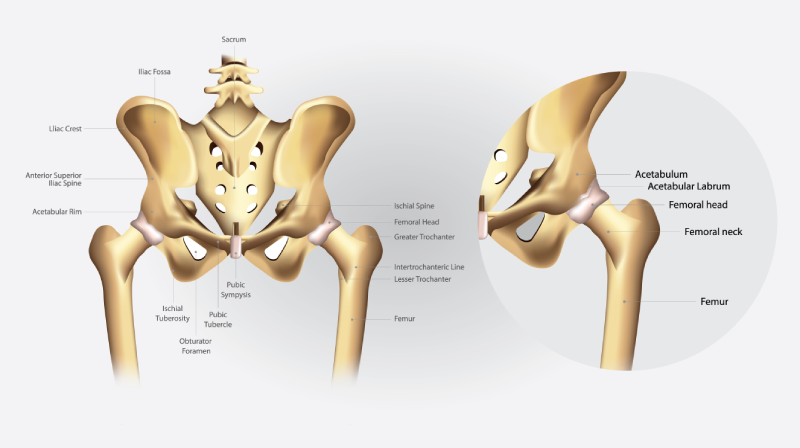
How Is Revision Hip Replacement Different From Primary Hip Replacement?
The prosthesis (implant) is made of ceramic, plastic, or metal components. Revision hip replacement becomes necessary when the components of the hip implant or the complete implant develop problems.
Surgeons use specialized implants or parts of the implant for revision hip replacement. Because of soft tissue and bone damage around the hip joint, surgeons find it difficult to use standard primary hip implants for revision hip replacement.
For this reason, they use specially designed implants for revision hip replacement to make up for damaged soft tissue and bones.
In some revision surgeries, only the parts of the implants or a few components are replaced. In some revisions, the entire implant is removed and replaced.
In some other cases, the whole prosthesis or implant removal demands rebuilding bone around the hip joint. For this reason, surgeons use bone grafts and metal pieces as substitutes for missing bone. They also use custom-made implants.
What Are the Reasons for a Revision Total Hip Replacement?
A total hip replacement fails for the following reasons:
Wear-and-Tear and Loosening of the Implant
An implant or prosthesis is cemented into place or press-fit into the bone. This is done to allow the bone to grow onto the components and fix them.
Sometimes, bone may fail to grow, or the components that were firmly fixed might loosen over time – resulting in hip pain and failure.
The damage to the implant can occur due to excessive body weight, repetitive high-impact activities, and wear of the plastic liner ball and the metal cap.
Infection
An infection can occur while in the hospital or when the patient goes home. It is one of the potential post-surgical complications.
Bacteria can attach to the implant or the surface around the prosthesis and cause infection.
In severe infection, the implant may loosen and detach from the bone, leading to pain, instability, and drainage.
Extensive use of antibiotics may not be enough to remove the infection completely. For this reason, doctors recommend revision surgery.
Recurrent Hip Dislocation
A natural hip joint is a ball-and-socket joint. The implant or prosthesis is an artificial ball-and-socket joint.
The implant works efficiently and better as long as the ball remains inside the socket. However, sitting in certain positions, injury, or trauma sometimes dislodges the ball from the socket. This is known as hip dislocation.
If you experience repeated hip dislocations, you may need revision surgery to better align your hip joint or to insert a special implant designed to prevent dislocations.
Fracture
A fracture can occur around the implant or its components. This type of fracture is known as a periprosthetic fracture.
Patients develop this type of fracture mostly due to falls. When a periprosthetic fracture occurs, your surgeon may recommend hip revision surgery.
Your doctor will look into several factors, such as the amount of remaining bone, the location of the fracture, or whether the implant is loose.
In some rare cases, the implant itself can break.
Reaction to Metal Ions or Allergy to Metals
Metal components of the implants can break down or wear. The tiny particles detach from the metal and fall off the device into the spaces surrounding it.
Some patients are sensitive to metals, and some may have an allergy to metals.
Other factors: Obesity, diabetes, and a very active lifestyle can all lead to implant failure in some cases.
Recovery After Revision Hip Replacement
After a revision hip replacement, you may stay in the hospital for 4 to 5 days.
Recovery after a revision surgery is often slower than after a primary hip replacement, but the care you receive is quite similar.
Revision Hip Replacement Requires Careful Planning
Revision hip replacement is a more complex procedure that may require specialized implants, instruments, bone grafts, or custom-made components depending on the condition of the existing implant, bone, and surrounding soft tissues.
A detailed assessment by an experienced orthopedic surgeon can help determine the appropriate approach for each individual case.
