
Bone Marrow Transplant for Cartilage Repair: Why Is It Needed & How Is It Performed?
Can your body's own bone marrow help repair damaged joint cartilage? For selected patients, bone marrow-based cartilage restoration techniques offer a promising approach to managing painful cartilage injuries while preserving the natural joint.
Does your knee keep hurting even after weeks of rest? Do you experience recurring swelling, stiffness, or difficulty climbing stairs? The problem could be damaged joint cartilage.
Healthy cartilage allows bones to glide smoothly against each other. However, injuries, repeated stress, and certain joint conditions can damage this protective surface.
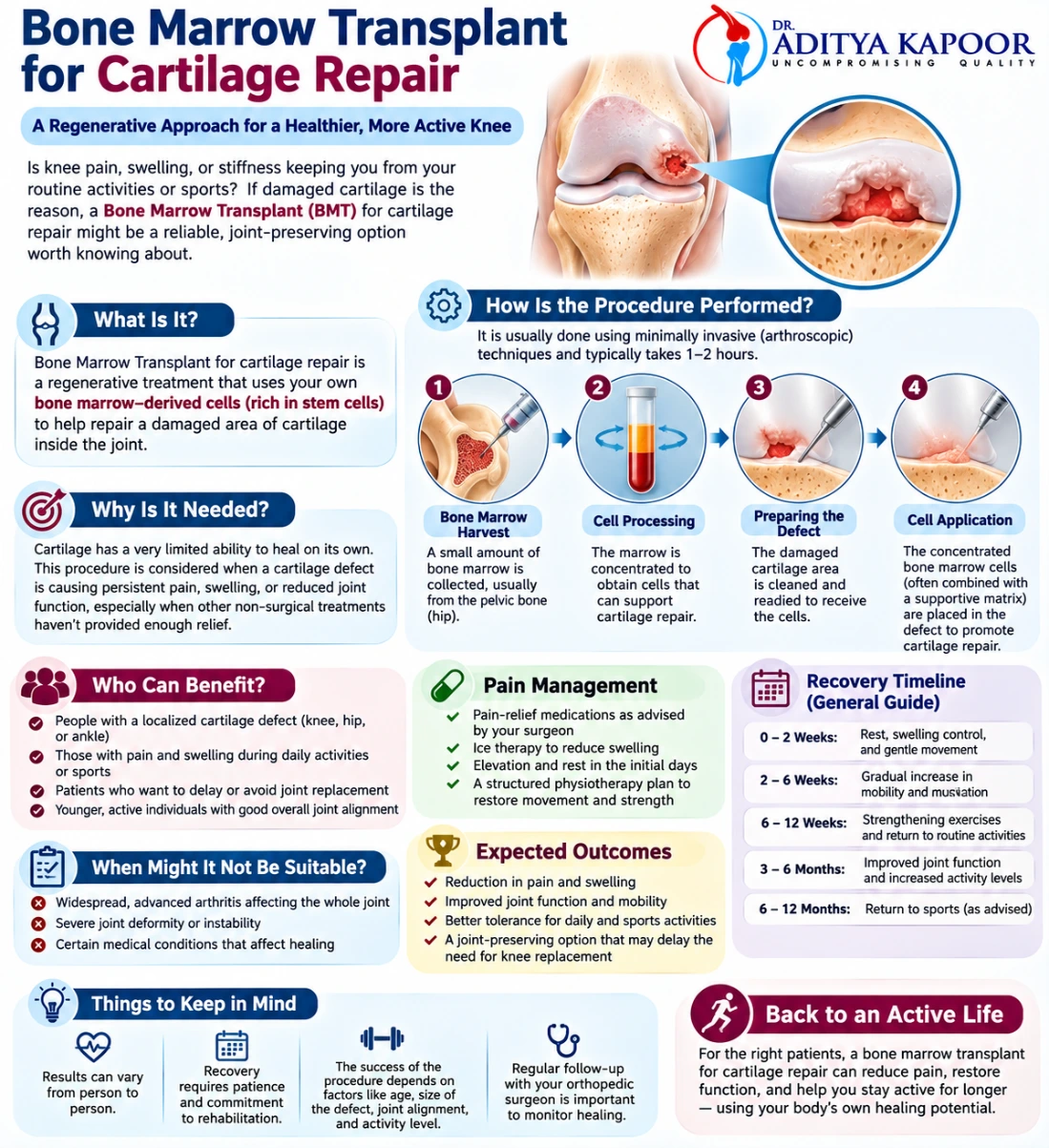
1. What Is Bone Marrow-Based Cartilage Repair?
Bone marrow is the soft tissue found inside bones. It contains blood-forming cells, connective tissue progenitor cells, growth factors, and other biological components involved in tissue maintenance and healing.
Bone marrow-based cartilage repair uses selected components of this tissue to support the treatment of damaged joint surfaces.
What Is Bone Marrow Aspirate Concentrate (BMAC)?
A commonly used approach is Bone Marrow Aspirate Concentrate (BMAC).
During this procedure, a small quantity of bone marrow is collected, usually from the pelvic bone, and processed to concentrate certain cellular and biological components.
The concentrate may then be applied to a cartilage defect, sometimes together with a scaffold, graft, or another cartilage restoration technique.
2. Why Is Cartilage Repair Necessary?
Imagine the cartilage in your knee as a smooth, protective coating that helps your bones move without excessive friction.
When this coating becomes damaged, joint movement may become painful.
Sports Injuries
Sudden twisting, jumping, or impact can damage cartilage.
Falls and Accidents
Trauma may injure cartilage and the underlying bone.
Osteochondral Lesions
Damage affects both cartilage and supporting bone.
Previous Ligament Injuries
ACL tears and other injuries may occur alongside cartilage defects.
Repetitive Joint Loading
Repeated stress may aggravate existing cartilage damage.
Some cartilage injuries remain stable and cause few symptoms. Others lead to recurring pain, swelling, and difficulty moving.
3. What Are the Warning Signs of Cartilage Damage?
Does your knee feel better after resting but become painful again when you walk, run, or climb stairs? This pattern can occur with cartilage injuries.
Persistent Joint Pain
Ongoing or recurring discomfort in the affected joint.
Swelling After Activity
Joint swelling following walking, exercise, or sports.
Stiffness
Reduced flexibility and difficulty moving the joint.
Clicking or Catching
Unusual sensations during joint movement.
Occasional Locking
A sensation that the joint temporarily gets stuck.
Difficulty with Activities
Difficulty squatting, climbing stairs, or participating in sports.
These symptoms can also occur with meniscus tears, ligament injuries, and osteoarthritis. A proper orthopaedic assessment is essential before considering cartilage restoration.
4. Why Might Bone Marrow-Based Cartilage Repair Be Recommended?
Does every cartilage injury require surgery or bone marrow treatment? Absolutely not.
Many patients improve with physiotherapy, activity modification, appropriate medication, and other nonsurgical treatments.
Bone marrow-based procedures may be considered for selected patients with localized cartilage defects that continue to cause symptoms.
Focal Cartilage Injuries
Localized defects may be suitable for cartilage restoration techniques, sometimes incorporating BMAC.
Osteochondral Defects
In selected cases, bone marrow-derived biological material may be used alongside procedures addressing cartilage and underlying bone damage.
Persistent Symptoms Despite Rehabilitation
Patients with ongoing pain and functional limitations may need further assessment for surgical treatment.
Joint-Preservation Surgery
BMAC may be used as an adjunct to certain cartilage repair procedures, depending on the surgeon's technique and available evidence.
5. How Is the Procedure Performed?
The exact technique depends on whether BMAC is used alone, with a scaffold, or alongside another cartilage restoration procedure.
Anaesthesia and Preparation
The procedure is performed under appropriate anaesthesia, depending on the treatment and the patient's condition. The affected joint and the bone marrow collection site are prepared using sterile techniques.
Collecting Bone Marrow
The surgeon typically collects bone marrow from the iliac crest, a part of the pelvic bone. A specialized needle is inserted into the bone, and a measured quantity of marrow is aspirated.
Processing the Marrow
The collected marrow is processed using a concentration system, often involving centrifugation. This separates and concentrates certain cellular components and biological factors.
Assessing the Cartilage Defect
If cartilage surgery is being performed, the surgeon may use an arthroscope to examine the joint. Damaged or unstable cartilage is assessed, and the defect is prepared according to the selected repair technique.
Applying the Concentrate
The prepared bone marrow concentrate may be delivered to the treatment area. Depending on the procedure, it may be combined with a scaffold, cartilage graft, or bone marrow stimulation technique. The aim is to support the biological environment for tissue repair.
Protecting the Treated Joint
After completing the procedure, the surgical sites are dressed. Crutches, a brace, or temporary weight-bearing restrictions may be necessary, particularly when BMAC is combined with cartilage surgery.
The duration varies considerably. An isolated marrow aspiration and injection may be relatively brief, while combined arthroscopic cartilage restoration can take one to two hours or longer.
6. Pain Management After the Procedure
Some soreness is expected, particularly around the marrow collection site and the treated joint. Pain levels depend on the procedure performed.
Prescribed Medication
Your doctor may recommend paracetamol or other suitable pain medication. Anti-inflammatory medicines should only be used when approved, particularly following cartilage restoration surgery.
Cold Therapy
Applying a wrapped ice pack for approximately 15–20 minutes may help reduce swelling and discomfort.
Rest and Elevation
Resting the treated joint and elevating the leg when appropriate may help control postoperative swelling.
Protected Weight-Bearing
Crutches may be required after surgical cartilage repair to avoid excessive loading of the treated area.
Physiotherapy
Supervised rehabilitation helps maintain joint mobility and gradually restore muscle strength.
7. Recovery: How Long Does It Take?
Recovery depends on the treatment performed. A simple BMAC injection and an extensive cartilage restoration procedure have very different rehabilitation requirements.
For BMAC-assisted cartilage surgery involving a weight-bearing knee defect, recovery may follow this general pattern.
Weeks 0–6: Protection and Initial Healing
The focus is on controlling pain and swelling and protecting the treated cartilage. Restricted weight-bearing may be necessary. Gentle physiotherapy exercises may begin according to the surgeon's protocol.
Weeks 6–12: Gradually Restoring Movement
Weight-bearing may increase when approved. Rehabilitation focuses on improving knee movement, muscle activation, and walking patterns.
Months 3–6: Building Strength
Patients gradually progress to strengthening, balance exercises, and low-impact activities.
Months 6–9: Advanced Rehabilitation
More demanding exercises may be introduced when the joint demonstrates adequate strength and function.
Months 9–12 and Beyond: Returning to Sports
Selected patients may return to higher-impact activities after appropriate assessment.
8. What Are the Expected Outcomes?
Bone marrow-based cartilage repair is an evolving area of orthopaedic medicine. Some clinical studies have reported improvements in pain and function following BMAC-assisted cartilage procedures.
Potential benefits may include:
Reduced Joint Pain
Potential improvement in discomfort associated with selected cartilage injuries.
Improved Movement
Potential improvement in movement and functional ability.
Support for Cartilage Restoration
Use as a biological adjunct in selected cartilage restoration techniques.
Patient-Derived Material
Use of biological material obtained from the patient's own body.
Joint Preservation
Potential role in preserving the natural joint in selected patients.
However, research findings vary. Many studies involve small patient groups, different surgical techniques, or BMAC combined with other treatments. As a result, it can be difficult to determine how much improvement comes specifically from the marrow concentrate.
9. What Are the Risks and Limitations?
Although marrow collection and arthroscopic techniques can be minimally invasive, they are not risk-free.
Collection-Site Discomfort
Pain or bruising at the marrow collection site.
Infection or Bleeding
Possible complications related to the procedure.
Joint Swelling or Stiffness
Temporary or persistent joint discomfort and reduced movement.
Persistent Symptoms
Symptoms may continue despite treatment.
Incomplete Cartilage Healing
The treated cartilage defect may not heal as expected.
Failure of Associated Repair
An associated cartilage repair may fail.
Further Treatment
Additional treatment may be required.
Treatment availability, regulatory requirements, and supporting evidence also vary by technique.
10. Frequently Asked Questions
Q1. Is BMAC the same as stem cell therapy?
Not exactly. BMAC contains a mixture of cells and biological components, including a relatively small population of connective tissue progenitor cells. It is not a purified stem cell product.
Q2. Can bone marrow treatment completely regenerate cartilage?
Complete regeneration of normal cartilage has not been reliably demonstrated. Some techniques may support repair tissue formation, but results vary.
Q3. Is BMAC better than microfracture?
Current evidence does not establish universal superiority. The most suitable treatment depends on the defect, joint condition, and individual patient factors.
Q4. Can BMAC prevent knee replacement?
There is insufficient evidence to guarantee that BMAC prevents or delays knee replacement.
Q5. Can I return to sports after treatment?
Some patients return to sports after rehabilitation, particularly following successful treatment of localized defects. Timing depends on the full procedure and functional recovery.
Explore the Right Approach to Cartilage Repair
Cartilage injuries can make everyday movements uncomfortable and interfere with an active lifestyle.
Bone marrow-based cartilage repair offers a developing biological approach that may have a role in selected joint-preservation procedures.
However, it is not a universal solution for cartilage damage or advanced arthritis.
The most important decision is not whether a treatment sounds innovative, but whether it is appropriate, evidence-supported, and suitable for your specific joint condition.
Accurate diagnosis, realistic expectations, careful surgical planning, and structured rehabilitation remain essential.
Expert Cartilage Repair & Joint Preservation in Hyderabad
Are you experiencing persistent knee pain, cartilage damage, recurring swelling, or difficulty returning to sports?
Consult Dr. Aditya Kapoor — Orthopedic Surgeon, Joint Replacement, Arthroscopy & Sports Medicine Specialist in Hyderabad, for an individualized assessment of cartilage injuries, osteochondral lesions, and joint-preserving treatment options.
Call +91 7799191082Protect your natural joints. Understand your treatment options and take an informed step toward improved movement and joint health.
