
High Tibial Osteotomy (HTO): Why Is It Needed & How Is It Performed?
Does knee pain make walking, climbing stairs, or enjoying your favourite activities increasingly difficult? What if correcting your leg alignment could help relieve pain while preserving your natural knee joint?
Knee pain is often associated with ageing, sports injuries, or arthritis. However, sometimes the underlying problem is not simply damaged cartilage—it is how your body weight is distributed across the knee.
When one side of the knee carries excessive pressure, the cartilage may wear down faster, causing pain, stiffness, and reduced mobility.
For selected patients, High Tibial Osteotomy (HTO) offers a joint-preserving surgical option that corrects leg alignment and redistributes pressure away from the damaged part of the knee.
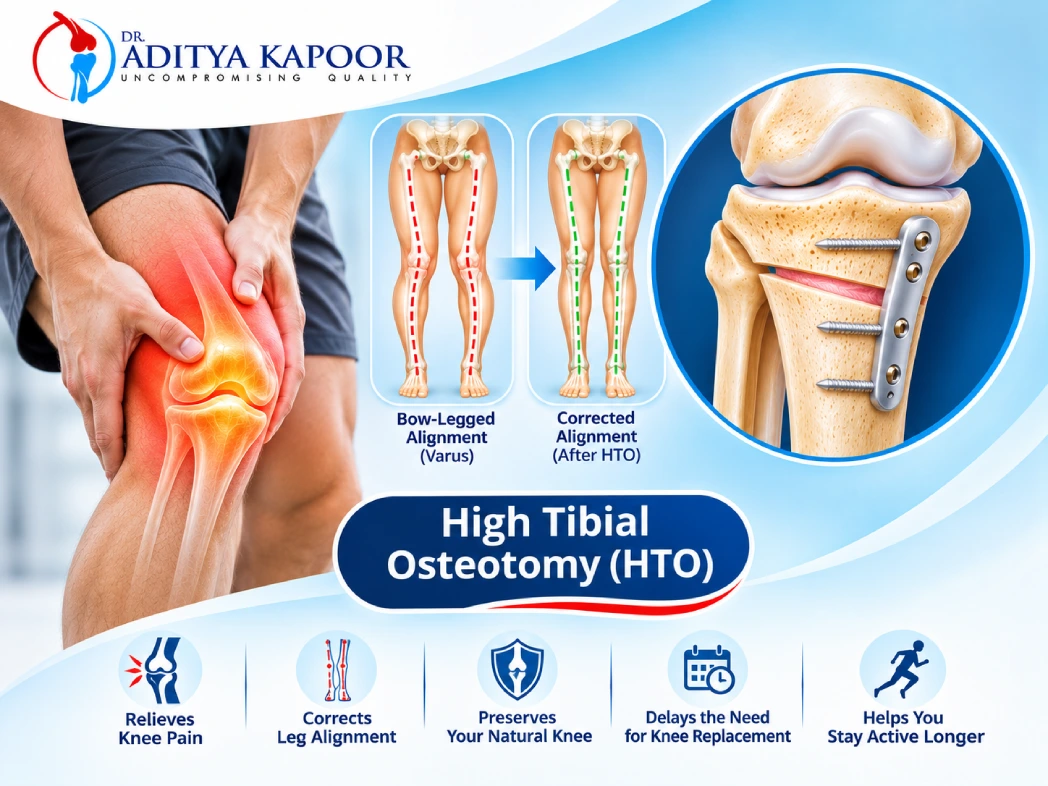
1. What Is High Tibial Osteotomy?
The tibia, commonly called the shinbone, is one of the two major bones of the lower leg. Its upper portion forms the lower part of the knee joint.
A healthy knee distributes body weight across its joint surfaces. However, when the leg is misaligned, one compartment may experience excessive pressure.
This is particularly common in people with bow-legged alignment, medically known as genu varum.
In bow-legged individuals, the mechanical axis of the leg may shift inward, increasing the load on the inner, or medial, compartment of the knee.
Over time, this uneven pressure can contribute to cartilage deterioration and osteoarthritis.
By shifting pressure away from the damaged compartment, the procedure aims to reduce pain, improve function, and preserve the natural joint.
2. Why Is High Tibial Osteotomy Needed?
Can knee pain caused by early arthritis improve without replacing the joint? For appropriately selected patients, the answer is yes.
When arthritis affects mainly one side of the knee, correcting the underlying alignment may reduce stress on the damaged cartilage.
When Might HTO Be Recommended?
1. Medial Compartment Osteoarthritis
HTO is commonly considered for patients with arthritis predominantly affecting the inner compartment of the knee, particularly when associated with bow-legged alignment.
2. Bow-Legged Deformity
Significant varus alignment may cause excessive loading of the medial knee compartment. Correcting the deformity can improve the distribution of forces across the joint.
3. Cartilage Injuries
HTO may be performed alongside selected cartilage restoration procedures when abnormal alignment places excessive pressure on the injured area.
4. Certain Ligament Injuries
Some complex knee ligament problems may require correction of abnormal alignment to improve joint stability and protect reconstructed ligaments.
5. Persistent Knee Pain Despite Conservative Treatment
Surgery may be considered when physiotherapy, medication, activity modification, and other nonsurgical treatments fail to provide adequate relief.
Who Is an Ideal Candidate?
HTO is often considered for younger or middle-aged, physically active patients with:
Localized Arthritis
Symptomatic arthritis mainly affecting one knee compartment.
Correctable Alignment
Correctable bow-legged alignment.
Preserved Cartilage
Reasonably preserved cartilage in the opposite compartment.
Adequate Knee Mobility
Sufficient knee mobility.
Commitment to Rehabilitation
Realistic expectations and willingness to complete rehabilitation.
Patients with advanced arthritis affecting multiple compartments may be better suited to knee replacement.
3. What Are the Symptoms That May Indicate a Need for HTO?
Have you noticed any of these problems?
Inner Knee Pain
Pain mainly on the inner side of the knee.
Pain During Walking or Standing
Discomfort that increases with walking or standing.
Difficulty with Daily Activities
Difficulty climbing stairs or squatting.
Swelling After Activity
Knee swelling after physical activity.
Visible Bow-Legged Alignment
Noticeable outward angling of the legs.
Reduced Walking Endurance
Difficulty returning to sports or exercise.
These symptoms do not automatically mean HTO is necessary. Your orthopedic surgeon must determine whether the discomfort is related to abnormal alignment, cartilage damage, ligament instability, or another condition.
How Is the Problem Diagnosed?
A detailed clinical examination is combined with imaging.
- Standing full-length leg X-rays: Especially important because they help determine the mechanical axis of the lower limb and identify the source of the deformity.
- Additional knee X-rays: May help assess the joint structure.
- MRI or CT scans: May be recommended to evaluate cartilage, ligaments, and bone anatomy.
4. How Is High Tibial Osteotomy Performed?
HTO is a specialized orthopedic procedure that involves making a carefully planned cut in the upper tibia and repositioning the bone to correct alignment.
Two commonly used techniques are opening-wedge and closing-wedge osteotomy.
Anaesthesia and Preparation
The operation is performed under general or regional anaesthesia. The patient is positioned on the operating table, and the affected leg is prepared using sterile techniques.
Planning and Confirming Alignment
Before surgery, the surgeon calculates the desired correction using standing alignment radiographs. During the operation, imaging guidance may help confirm the position and accuracy of the osteotomy.
Making the Bone Cut
The surgeon makes an incision near the upper tibia and creates a controlled cut in the bone. The method depends on the required correction.
Two Common HTO Techniques
Medial Opening-Wedge Osteotomy
A controlled gap is gradually opened on the inner side of the upper tibia.
This changes the alignment of the leg and shifts weight-bearing forces away from the overloaded medial compartment.
Bone graft or a bone substitute may be used in selected cases.
Lateral Closing-Wedge Osteotomy
A precisely measured wedge of bone is removed from the outer side of the upper tibia.
The remaining bone surfaces are brought together to achieve the planned correction.
Both techniques have advantages and limitations, and the surgeon selects the approach based on the patient's anatomy and clinical needs.
Fixing the Corrected Bone
Once the desired alignment is achieved, the bone is stabilized using a specially designed metal plate and screws. The implants maintain the correction while the bone heals.
Checking Alignment and Stability
The surgeon assesses the final alignment and fixation stability. Imaging may be used to verify the correction.
Closing the Incision
The wound is closed and covered with sterile dressings. Depending on the procedure, a brace, crutches, or temporary weight-bearing restrictions may be recommended.
Many isolated procedures take approximately 1–2 hours, although complex corrections or additional cartilage and ligament procedures may require longer.
5. Pain Management After High Tibial Osteotomy
Because HTO involves cutting and repositioning bone, postoperative pain and swelling are expected, particularly during the first few days. However, modern pain-management strategies can help improve comfort.
Prescribed Medication
Your surgeon may recommend paracetamol, suitable anti-inflammatory medicines, or short-term stronger pain relief when necessary. Medication choices may depend on your medical history and the surgeon's bone-healing protocol.
Regional Nerve Blocks
Some patients receive regional anaesthesia or a nerve block to reduce discomfort during the early postoperative period.
Cold Therapy
Applying a wrapped ice pack for approximately 15–20 minutes at a time may help reduce swelling and pain. Avoid placing ice directly on the skin.
Elevation
Keeping the operated leg elevated when resting may help control swelling.
Protected Weight-Bearing
Crutches or a walker may be necessary while the bone begins healing. Follow your surgeon's instructions carefully to avoid excessive stress on the osteotomy.
Physiotherapy
Supervised exercises help maintain knee mobility, activate surrounding muscles, and gradually restore strength.
6. Recovery After HTO: How Long Does It Take?
Recovery after high tibial osteotomy takes time because the repositioned bone must heal securely.
The rehabilitation programme depends on the surgical technique, fixation stability, associated procedures, and individual healing.
Phase 1: Weeks 0–6 — Protection and Initial Healing
The focus is on controlling pain and swelling, protecting the osteotomy, and maintaining approved knee movement. Patients commonly require crutches and restricted weight-bearing. Gentle range-of-motion and muscle activation exercises may begin under physiotherapy supervision.
Phase 2: Weeks 6–12 — Gradually Increasing Weight-Bearing
Follow-up X-rays help assess bone healing. Depending on the findings, the surgeon may progressively increase weight-bearing. Physiotherapy focuses on improving walking patterns, knee movement, and muscle strength.
Phase 3: Months 3–6 — Building Strength and Mobility
As bone healing progresses, rehabilitation becomes more active. Exercises may focus on the quadriceps, hamstrings, hip muscles, balance, and functional movement. Many patients gradually return to routine activities during this period.
Phase 4: Months 6–9 — Advanced Rehabilitation
Patients may begin more demanding strengthening and recreational activities when clinically appropriate. Low-impact exercises are often encouraged. Running, jumping, and high-impact activities require specific medical clearance.
Phase 5: Months 9–12 and Beyond — Returning to Sports
Some patients return to higher-demand activities within approximately 9–12 months. However, recovery may take longer when HTO is combined with cartilage restoration or ligament reconstruction.
7. What Are the Expected Outcomes of High Tibial Osteotomy?
For carefully selected patients, HTO can provide meaningful improvements in knee pain, alignment, and function.
Reduced Compartment Pressure
Reduced pressure on the damaged knee compartment.
Improved Alignment
Improved lower-limb alignment.
Reduced Knee Pain
Reduced activity-related knee pain.
Better Mobility
Better walking and exercise tolerance.
Natural Joint Preservation
Preservation of the natural knee joint.
Potentially Delayed Replacement
Potential postponement of knee replacement surgery.
How Successful Is HTO?
Published studies have reported encouraging medium- and long-term results.
However, results vary considerably, and these figures should not be interpreted as a guaranteed outcome.
What Influences Long-Term Success?
- Severity and distribution of arthritis.
- Accuracy of alignment correction.
- Age and activity level.
- Body weight.
- Bone healing.
- Associated cartilage or ligament injuries.
- Commitment to rehabilitation.
HTO does not reverse all existing cartilage damage or permanently prevent arthritis progression.
8. Are There Any Risks or Complications?
Like any major orthopedic operation, HTO carries certain risks.
Infection or Bleeding
Possible complications related to the surgical procedure.
Blood Clots
Blood clots may develop during the postoperative period.
Delayed Bone Healing or Non-union
The repositioned bone may take longer than expected to heal or may fail to unite.
Loss of Correction or Fixation Failure
The corrected alignment or fixation may not remain as intended.
Knee Stiffness
Reduced knee movement may occur during recovery.
Nerve or Blood Vessel Injury
Injury to nearby nerves or blood vessels is a possible complication.
Persistent Pain
Some patients may continue to experience knee discomfort.
Implant Irritation
The metal plate or screws may cause irritation after surgery.
Additional Surgery
Some patients may require further surgery or future knee replacement.
Some patients may require plate removal after healing if the implant causes persistent discomfort.
9. Frequently Asked Questions About HTO
Q1. Is high tibial osteotomy better than knee replacement?
Neither procedure is universally better. HTO may be suitable for selected active patients with localized arthritis and correctable malalignment, while knee replacement may be more appropriate for advanced, widespread joint degeneration.
Q2. Can HTO permanently cure knee arthritis?
No. HTO changes joint loading but does not completely regenerate damaged cartilage or eliminate future arthritis risk.
Q3. Will I be able to walk after surgery?
Yes, but crutches and temporary weight-bearing restrictions are commonly required during early recovery.
Q4. Will the metal plate remain in my leg permanently?
The plate can remain in place if it causes no problems. Removal may be considered after bone healing if the implant becomes symptomatic.
Q5. Can I return to sports after HTO?
Many patients return to recreational activities following successful rehabilitation. High-impact sports require individualized assessment and clearance.
10. When Should You Consult an Orthopedic Specialist?
If you experience persistent inner knee pain, visible bow-legged alignment, reduced mobility, or worsening symptoms despite treatment, an orthopedic evaluation may help identify the underlying cause.
Not every painful or misaligned knee requires surgery.
An orthopedic specialist can determine whether physiotherapy, medication, weight management, joint-preserving surgery, or knee replacement is most appropriate.
Preserve Your Natural Knee, Restore Your Mobility
Living with chronic knee pain can limit your independence, physical activity, and quality of life.
For selected patients, high tibial osteotomy offers an effective joint-preserving option by correcting abnormal alignment and reducing excessive pressure on damaged knee cartilage.
Although recovery requires patience, careful rehabilitation, and regular follow-up, many patients experience meaningful improvements in comfort and mobility.
The key to successful HTO treatment is accurate diagnosis, precise surgical planning, appropriate patient selection, and a structured rehabilitation programme.
Expert High Tibial Osteotomy & Knee Preservation in Hyderabad
Are you struggling with persistent knee pain, bow-legged deformity, or difficulty walking and performing everyday activities?
Consult Dr. Aditya Kapoor — Orthopedic Surgeon, Joint Replacement, Arthroscopy & Sports Medicine Specialist in Hyderabad, for personalized evaluation of knee alignment problems, cartilage injuries, arthritis, and suitable joint-preserving treatment options.
Book Your Consultation TodayYour natural knee deserves the right care. Take the first step toward better alignment, improved mobility, and a more active life.
