
AutoCart Procedure: An Advanced Cartilage Repair Technique
Restore Joint Health and Mobility
Are you experiencing persistent knee pain, swelling, or difficulty moving after a sports injury? What if damaged cartilage could be treated using your body's own healthy cartilage tissue?
Healthy joints allow us to walk, run, climb stairs, and perform everyday activities without thinking twice. But when the smooth cartilage covering the ends of our bones becomes damaged, even simple movements can become painful.
One innovative technique is the AutoCart procedure, a single-stage surgical approach that uses a patient's own cartilage tissue to treat selected cartilage defects.
1. What Is the AutoCart Procedure?
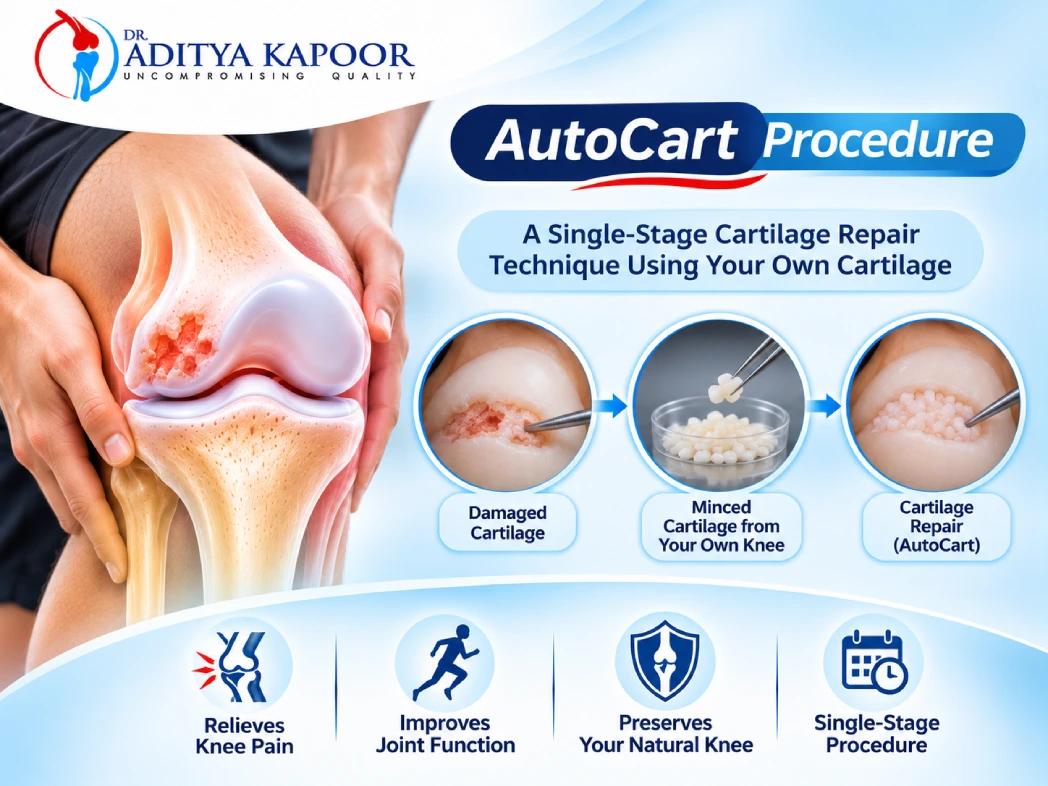
AutoCart is an autologous minced cartilage repair technique designed to treat selected areas of damaged articular cartilage.
The term autologous means that the tissue used for treatment comes from the patient's own body.
During the procedure, the orthopedic surgeon collects a small amount of healthy cartilage, processes it into tiny fragments, and places these fragments into the damaged cartilage area.
The cartilage particles are typically combined with biological materials, such as platelet-rich plasma (PRP), and stabilized using fibrin-based products, depending on the technique.
These materials help hold the cartilage fragments within the defect and support the local repair environment.
However, it is important to understand that AutoCart does not guarantee regeneration of cartilage identical to the original healthy tissue.
2. Why Is Cartilage Repair Necessary?
Imagine the cartilage in your knee as a smooth protective cushion that allows the bones to glide comfortably against each other.
When this protective layer becomes damaged, movement may create irritation, inflammation, and discomfort.
Sports Injuries
Sudden twisting, jumping, pivoting, or direct impact may damage the joint surface.
Accidents and Falls
Trauma can cause cartilage defects or injuries involving the underlying bone.
Repetitive Joint Stress
Repeated loading may contribute to cartilage damage in susceptible individuals.
Previous Ligament Injuries
ACL tears and other joint injuries may occur alongside cartilage defects.
Osteochondral Injuries
Damage may involve both the cartilage and the bone immediately beneath it.
Because articular cartilage has no direct blood supply, its natural healing capacity is limited.
Untreated symptomatic defects may continue to cause pain and functional limitations, although not every cartilage injury progresses or requires surgery.
3. What Are the Symptoms of Cartilage Damage?
Does your knee feel comfortable at rest but become painful or swollen after walking, exercising, or climbing stairs? This could indicate a cartilage problem, although several other joint conditions produce similar symptoms.
Persistent Joint Pain
Recurring discomfort in the affected joint.
Swelling After Activity
Joint swelling following physical activity.
Stiffness
Restricted movement and reduced flexibility.
Clicking or Catching
Unusual sensations during joint movement.
Squatting or Stair Difficulty
Discomfort during squatting or stair climbing.
Difficulty Returning to Sports
Reduced ability or confidence when resuming sports.
A clinical examination and appropriate imaging are necessary to identify the underlying cause.
4. Why Is the AutoCart Procedure Needed?
Does every cartilage injury require AutoCart surgery? No.
Small or minimally symptomatic cartilage injuries may sometimes be managed with physiotherapy, activity modification, weight management when appropriate, and other nonsurgical treatments.
However, surgery may be considered when a localized cartilage defect causes persistent symptoms despite appropriate conservative care.
When Might AutoCart Be Recommended?
Localized Cartilage Defects
AutoCart may be considered for selected focal cartilage defects, particularly when the surrounding cartilage remains reasonably healthy.
Persistent Joint Pain
Patients whose symptoms continue despite rehabilitation and appropriate nonsurgical treatment may require further evaluation.
Sports-Related Cartilage Injuries
Physically active patients with suitable cartilage defects may benefit from a joint-preserving treatment approach.
Cartilage Damage Affecting Daily Activities
Pain or swelling that interferes with walking, exercise, or work may justify considering surgical treatment.
Selected Joint-Preservation Cases
AutoCart may form part of a broader treatment plan when associated alignment or stability problems are also addressed.
Who May Not Be an Ideal Candidate?
AutoCart is generally not intended to treat widespread, advanced osteoarthritis involving extensive cartilage loss throughout the joint.
The surgeon must consider defect size, depth, location, subchondral bone condition, joint alignment, ligament stability, age, and activity requirements.
5. How Is the AutoCart Procedure Performed?
AutoCart is generally performed using arthroscopic or arthroscopic-assisted surgical techniques. The precise steps depend on the affected joint, cartilage defect, and surgeon's preferred method.
Anaesthesia and Preparation
The procedure is performed under appropriate anaesthesia, commonly general or regional anaesthesia. The affected joint is prepared under sterile conditions.
Examining the Cartilage Damage
The surgeon introduces an arthroscope, a small camera, through a tiny incision. This provides a detailed view of the cartilage surfaces and surrounding joint structures. The damaged area is examined to determine its size, depth, and suitability for treatment.
Preparing the Cartilage Defect
Loose or unstable cartilage is carefully removed. The surgeon prepares the edges and base of the defect to create a stable area for the cartilage fragments.
Harvesting Healthy Cartilage
A small amount of healthy cartilage is collected from a suitable, relatively low-load area of the same joint. The surgeon takes care to minimize damage to the donor site.
Preparing the Cartilage Fragments
The harvested cartilage is processed into small particles. These fragments contain cartilage tissue and cells that may contribute to the repair process. Depending on the technique, the particles may be combined with PRP or other biological materials.
Placing the Cartilage Into the Defect
The prepared cartilage fragments are carefully distributed within the damaged area. A fibrin-based adhesive or sealant may be used to stabilize the particles. The surgeon checks that the material remains appropriately positioned.
Closing and Protecting the Joint
After completing the repair, the surgical instruments are removed and the incisions are closed. Crutches, a brace, or restricted weight-bearing may be recommended to protect the treated area.
The duration varies with the defect and any additional procedures. An isolated procedure may take approximately one to two hours, although complex cases can require longer.
6. Pain Management After the AutoCart Procedure
Some postoperative pain, swelling, and stiffness are expected, especially during the first few days. However, discomfort can usually be managed with a planned combination of treatments.
Prescribed Pain Medication
Your surgeon may recommend paracetamol or other suitable pain-relieving medicines. Anti-inflammatory medications should be taken only when approved, because recommendations may differ between cartilage restoration protocols.
Cold Therapy
Applying a wrapped ice pack for approximately 15–20 minutes at a time may help reduce pain and swelling.
Elevation
For knee or ankle procedures, keeping the operated leg elevated while resting may help control swelling.
Protected Weight-Bearing
Crutches or a brace may be required to avoid excessive pressure on the healing cartilage.
Physiotherapy
Gentle, controlled movement is often introduced during early rehabilitation to maintain joint mobility while protecting the repair.
7. Recovery After AutoCart: How Long Does It Take?
Cartilage repair requires patience. Although the surgical incisions may heal relatively quickly, the repaired joint surface needs considerably more time to mature.
Recovery depends on the size and location of the defect, the joint involved, and whether additional procedures were performed.
Phase 1: Weeks 0–6 — Protecting the Repair
The focus is on reducing swelling, controlling pain, and protecting the cartilage fragments. Patients may require crutches and restricted weight-bearing, particularly for defects in weight-bearing areas. Supervised range-of-motion exercises may begin according to the surgeon's protocol.
Phase 2: Weeks 6–12 — Restoring Movement
Weight-bearing may be increased gradually when approved. Physiotherapy focuses on restoring joint mobility, muscle activation, and normal walking patterns.
Phase 3: Months 3–6 — Building Strength
Rehabilitation becomes more active. Exercises may include progressive strengthening, balance training, and low-impact functional movements. Activities such as stationary cycling may be introduced when appropriate.
Phase 4: Months 6–9 — Advanced Rehabilitation
Patients may progress toward more demanding strengthening and recreational activities. Running or impact-based exercise should begin only after appropriate clinical assessment and clearance.
Phase 5: Months 9–12 and Beyond — Returning to Sports
Some patients may return to higher-demand sporting activities around nine to twelve months or later. However, AutoCart-specific rehabilitation evidence remains limited, and there is no universally established return-to-sport timeline.
8. What Are the Expected Outcomes of AutoCart?
For carefully selected patients, AutoCart may help reduce pain and improve joint function.
Localized Defect Treatment
Treatment of selected localized cartilage defects.
Patient's Own Cartilage
Use of the patient's own cartilage tissue.
Single-Stage Approach
A single-stage surgical approach.
Arthroscopic-Assisted Treatment
Minimally invasive or arthroscopic-assisted treatment in suitable cases.
Improved Function
Potential improvement in mobility and activity tolerance.
Natural Joint Preservation
Potential preservation of the natural joint.
How Successful Is AutoCart?
Early clinical studies of autologous minced cartilage techniques have reported encouraging improvements in patient-reported pain and knee function.
However, long-term evidence for AutoCart remains more limited than for some established cartilage restoration procedures.
What Factors Influence the Results?
- Size and location of the cartilage defect.
- Condition of the underlying bone.
- Quality of the surrounding cartilage.
- Joint alignment and ligament stability.
- Patient age and activity requirements.
- Associated injuries.
- Rehabilitation adherence.
9. Are There Any Risks or Complications?
Although AutoCart can be performed using minimally invasive techniques, it remains a surgical procedure.
Infection or Bleeding
Possible complications related to surgery.
Joint Stiffness
Reduced joint movement during recovery.
Persistent Pain or Swelling
Symptoms may continue after treatment.
Blood Clots
Blood clots may develop during the postoperative period.
Incomplete Cartilage Healing
The cartilage repair may not heal as expected.
Repair Displacement or Failure
The cartilage fragments or repair may not remain stable.
Donor-Site Discomfort
Discomfort may occur where healthy cartilage was collected.
Continued Cartilage Degeneration
Joint degeneration may continue despite treatment.
Additional Surgery
Further treatment or surgery may be required.
Your orthopedic surgeon should explain the expected benefits, limitations, and risks based on your individual condition.
10. Frequently Asked Questions About AutoCart
Q1. Is AutoCart the same as knee replacement?
No. AutoCart is a cartilage repair technique intended for selected localized defects. Knee replacement involves replacing damaged joint surfaces with artificial components.
Q2. Is AutoCart better than microfracture?
Not necessarily. Both procedures have different indications. Although AutoCart is designed to introduce cartilage tissue into the defect, current evidence does not establish that it is superior for every patient.
Q3. Can AutoCart regenerate completely normal cartilage?
The technique aims to support cartilage repair, but restoration of tissue identical to native healthy cartilage cannot be guaranteed.
Q4. Will I need crutches after surgery?
Possibly. Many patients require protected weight-bearing during early recovery, particularly when the treated defect is located on a weight-bearing surface.
Q5. Can I return to sports after AutoCart?
Some patients return to sports after successful rehabilitation. The timing depends on healing, strength, joint function, and medical clearance.
11. When Should You Consult an Orthopedic Specialist?
If you experience persistent knee pain, recurring swelling, painful clicking, or difficulty returning to physical activity after an injury, an orthopedic evaluation may help identify cartilage damage.
Your doctor may recommend X-rays and MRI to assess the joint.
An orthopedic specialist can determine whether nonsurgical management, AutoCart, or another cartilage restoration technique is appropriate.
Preserve Your Cartilage, Protect Your Natural Joint
Cartilage damage can make everyday movements uncomfortable and prevent you from enjoying an active lifestyle.
Fortunately, advances in joint-preserving orthopedic surgery have introduced new options for treating selected cartilage injuries.
AutoCart represents a promising single-stage technique that uses a patient's own cartilage tissue to support repair.
However, successful treatment depends on careful patient selection, accurate diagnosis, appropriate surgical technique, and a structured rehabilitation programme.
Expert Cartilage Repair & Joint Preservation in Hyderabad
Are you struggling with persistent knee pain, cartilage damage, recurring swelling, or difficulty returning to sports?
Consult Dr. Aditya Kapoor — Orthopedic Surgeon, Joint Replacement, Arthroscopy & Sports Medicine Specialist in Hyderabad, for personalized evaluation of cartilage injuries, osteochondral lesions, ligament injuries, and joint-preserving treatment options.
Book Your Consultation TodayDon't let cartilage damage limit your movement. Explore the right treatment options and take the first step toward improved joint comfort, mobility, and confidence.
