
Ligament Repair Surgery: Why Is It Needed & How Is It Performed?
Understand ligament injuries, surgical repair and reconstruction, treatment options, and the journey toward restoring joint stability.
Have you ever twisted your knee, landed awkwardly during a game, or experienced a sudden injury that left your joint feeling unstable? A damaged ligament could be the reason.
Whether you're a professional athlete, a fitness enthusiast, or someone who enjoys an active lifestyle, ligament injuries can disrupt your everyday routine.
A simple movement like climbing stairs, walking on uneven ground, or turning suddenly may become painful or difficult.
While some ligament injuries heal with rest and rehabilitation, severe tears may require surgical treatment to restore joint stability.
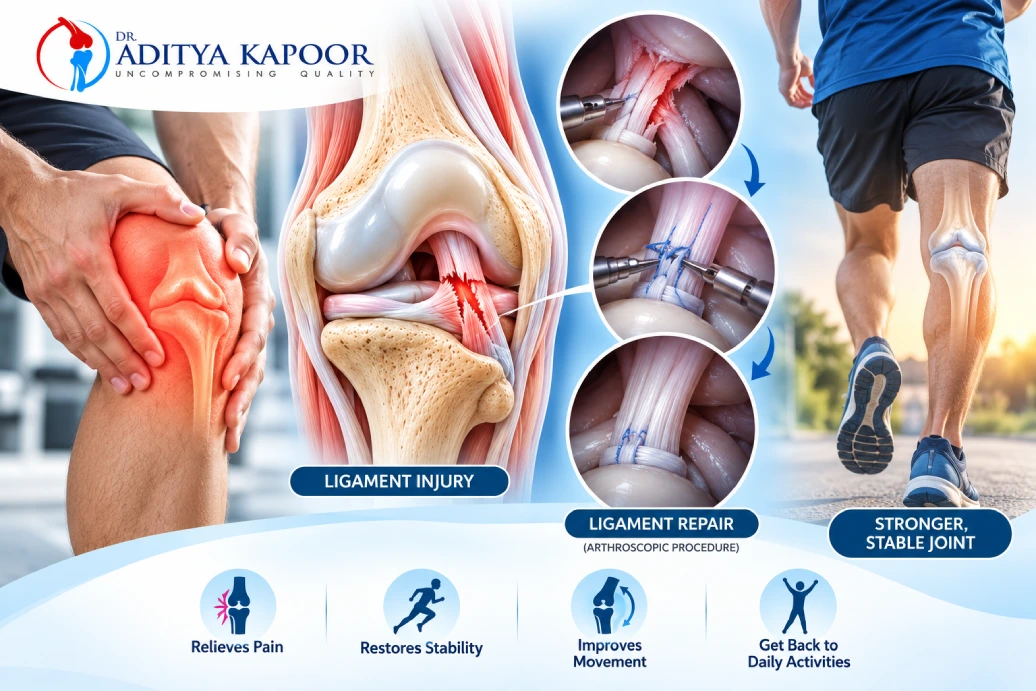
What Are Ligaments, and Why Are They Important?
Ligaments are strong bands of connective tissue that connect one bone to another. Think of them as the body's natural stabilizing straps.
They hold joints together, guide movement, and prevent excessive motion that could cause injury.
Ligaments are present throughout the body, including the knees, shoulders, ankles, elbows, and wrists.
The Four Major Stabilizing Ligaments of the Knee
Anterior Cruciate Ligament (ACL)
Helps prevent excessive forward movement and rotation of the shinbone.
Posterior Cruciate Ligament (PCL)
Prevents excessive backward movement of the shinbone.
Medial Collateral Ligament (MCL)
Supports the inner side of the knee and helps maintain joint stability.
Lateral Collateral Ligament (LCL)
Supports the outer side of the knee and helps control excessive sideways movement.
When a ligament becomes stretched or torn, the affected joint may lose some of its stability. This can make everyday movements and sporting activities difficult.
What Causes Ligament Injuries?
Ligament injuries can happen suddenly, often during movements that place excessive stress on a joint.
Sports Injuries
Sudden turns, jumping, twisting, or rapid changes in direction can damage ligaments, particularly in football, cricket, basketball, and badminton.
Falls and Accidents
Slipping, falling, or experiencing a road traffic accident may place abnormal force on a joint.
Direct Impact
A collision during contact sports or a forceful blow to the knee or shoulder can cause ligament damage.
Overstretching
Moving a joint beyond its normal range may stretch or tear its supporting ligaments.
Previous Joint Injuries
Earlier ligament damage may contribute to recurrent instability, especially when rehabilitation has been incomplete.
How Can You Recognize a Ligament Injury?
Does your joint feel as though it might suddenly give way when you walk, turn, or change direction?
This feeling of instability may indicate damage to the ligaments responsible for supporting the joint.
Sudden Pain
Pain may develop immediately following an injury or an awkward movement.
Swelling
Swelling around the affected joint may develop after ligament damage.
Popping Sensation
Some patients experience a popping sensation at the time of injury.
Joint Instability
The affected joint may feel unstable, buckle, or give way during movement.
Difficulty Bearing Weight
Walking or placing weight on the affected limb may become uncomfortable or difficult.
Reduced Movement
The joint may become difficult to bend or straighten completely.
Symptoms vary according to the ligament involved and the severity of the injury. A popping sound does not always indicate a ligament tear, and some significant injuries occur without an audible pop.
Why Is Ligament Repair Needed?
Does every torn ligament require surgery? Absolutely not.
Many partial tears and even some complete ligament injuries can be treated successfully without an operation.
Treatment depends on the affected ligament, severity of the tear, joint stability, associated injuries, and the patient's activity requirements.
When Might Surgery Be Recommended?
Complete Ligament Tears With Significant Instability
Some severe injuries leave the joint unstable during routine activities or sports.
Persistent Instability Despite Physiotherapy
When structured rehabilitation fails to restore adequate joint control, surgical treatment may be considered.
Multiple Ligament Injuries
Damage involving several stabilizing ligaments may require surgical intervention to restore joint alignment and function.
Associated Joint Injuries
Ligament tears accompanied by certain meniscus injuries, cartilage damage, fractures, or other structural problems may require surgery.
High-Demand Physical Activities
Athletes participating in pivoting or contact sports may benefit from surgical stabilization when their injury and functional requirements justify it.
Restore joint stability, improve function, and reduce repeated episodes of giving way.
However, surgery does not guarantee that arthritis or future joint injuries will be prevented.
Ligament Repair vs. Ligament Reconstruction: What's the Difference?
These terms are often used interchangeably, but they describe different surgical techniques.
Ligament Repair
In a repair procedure, the surgeon reattaches or sutures the patient's existing ligament tissue.
This may be appropriate for certain fresh tears where the ligament has separated near its attachment and the remaining tissue is suitable for repair.
Common Techniques
- Strong surgical sutures.
- Suture anchors.
- Other appropriate fixation devices.
Ligament Reconstruction
When the damaged ligament cannot be reliably repaired, the surgeon may replace it with a tendon graft.
The graft may come from the patient's own body or, in selected circumstances, from donor tissue.
Example
ACL reconstruction is more commonly performed than primary ACL repair for many complete ACL tears.
The choice depends on the specific ligament, tear pattern, tissue quality, and individual circumstances.
How Is Ligament Repair Surgery Performed?
Ligament surgery may be performed arthroscopically, through an open approach, or using a combination of techniques.
The procedure varies significantly between ACL, PCL, collateral ligament, ankle ligament, and shoulder ligament injuries. The following steps provide a general overview.
Anaesthesia and Preparation
The procedure is performed under suitable anaesthesia, often general or regional anaesthesia.
The surgical team positions the patient and prepares the affected joint under sterile conditions.
Assessing the Ligament Damage
The surgeon examines the injured structures. In arthroscopic procedures, a small camera is inserted through a tiny incision to provide a detailed view of the joint.
Associated injuries may also be identified.
Repairing or Reconstructing the Ligament
For suitable repairable tears, the surgeon may use strong sutures, anchors, or other fixation devices to reattach the ligament.
For reconstruction, a tendon graft is positioned to replace the damaged ligament and secured using appropriate fixation methods.
Checking Joint Stability
The surgeon evaluates the repaired or reconstructed ligament to assess joint stability and the adequacy of fixation.
Closing and Protecting the Joint
The incisions are closed and covered with sterile dressings.
Depending on the procedure, the patient may require a brace, sling, or temporary movement restrictions.
How Long Does Ligament Surgery Take?
Many isolated procedures take approximately one to two hours, although complex or multiple-ligament surgeries can take considerably longer.
Pain Management After Ligament Repair
Some pain, swelling, and stiffness are expected during the early postoperative period. Modern pain-management strategies can help make recovery more comfortable.
Prescribed Medication
Your surgeon may recommend paracetamol, appropriate anti-inflammatory medication, or short-term stronger pain relief when needed.
Regional nerve blocks may also provide pain relief during the initial postoperative period.
Cold Therapy
Applying a wrapped ice pack for approximately 15–20 minutes at a time may help reduce pain and swelling.
Elevation and Support
For lower-limb surgery, appropriate elevation may help control swelling.
Braces or slings should be used according to the surgeon's instructions.
Physiotherapy
Controlled movement and rehabilitation exercises help restore joint mobility, strength, and function.
Exercises must be introduced according to the specific repair or reconstruction protocol.
Adequate Rest
Good sleep, balanced nutrition, and following activity restrictions support recovery.
Seek medical attention if you develop fever, increasing wound redness, unusual discharge, worsening pain, or new numbness.
Severe calf swelling, chest pain, or sudden breathlessness requires urgent assessment.
Recovery After Ligament Repair: How Long Does It Take?
Recovery varies considerably depending on the injured ligament, surgical technique, associated injuries, and individual healing.
The following is a broad rehabilitation timeline often associated with major knee ligament reconstruction.
Initial Healing
The focus is on controlling pain and swelling, protecting the surgical site, and beginning approved mobility exercises.
Some patients require crutches or a brace. Weight-bearing restrictions depend on the procedure.
Restoring Movement
Physiotherapy generally focuses on gradually improving range of motion and activating the surrounding muscles.
Walking patterns and basic daily activities may progressively improve.
Building Strength
Strengthening exercises become more structured. The rehabilitation programme may include balance training, controlled functional movements, and exercises to improve joint stability.
Functional Rehabilitation
Patients may progress to more demanding strengthening and sport-specific exercises when clinically appropriate.
Running or jumping activities are introduced only after meeting relevant rehabilitation criteria.
Returning to Sports
Return to sport depends on the specific ligament and procedure.
For example, return to unrestricted pivoting sports after ACL reconstruction often requires approximately 9–12 months or longer, along with satisfactory strength, movement, and functional testing.
Other ligament repairs may follow shorter or longer rehabilitation protocols.
It is about whether your joint has regained the strength, control, and stability required for your activities.
What Are the Expected Outcomes of Ligament Repair?
For appropriately selected patients, ligament repair or reconstruction can significantly improve joint stability and function.
Reduced Instability
Treatment may reduce repeated episodes of joint instability and giving way.
Improved Movement
Rehabilitation can help improve joint movement and confidence during everyday activities.
Better Daily Function
Patients may regain the ability to perform routine activities more comfortably.
Return to Exercise and Sports
Appropriate treatment and rehabilitation may improve participation in exercise and sporting activities.
However, outcomes depend on the ligament involved, severity of injury, surgical technique, associated joint damage, and rehabilitation progress.
Are There Any Possible Complications?
Like any operation, ligament surgery carries risks. These may include:
- Infection or bleeding.
- Joint stiffness.
- Blood clots, particularly after lower-limb surgery.
- Nerve or blood vessel injury.
- Persistent pain or instability.
- Failure or re-tearing of the repaired or reconstructed ligament.
- Problems related to graft harvesting or fixation devices.
A detailed consultation helps patients understand the potential benefits, limitations, and risks of ligament surgery.
Frequently Asked Questions About Ligament Repair
1. Can a Completely Torn Ligament Heal Without Surgery?
Some complete ligament tears can heal or become functionally manageable with appropriate bracing and rehabilitation. Others, particularly certain ACL injuries, may not heal reliably and can require reconstruction when instability persists.
2. Is Ligament Repair a Major Surgery?
The complexity depends on the ligament and procedure. Some repairs are relatively straightforward, while multi-ligament reconstructions are major orthopedic operations.
3. Can I Walk After Ligament Surgery?
Many patients begin walking with assistance relatively early, but weight-bearing restrictions vary. Always follow the specific postoperative protocol.
4. Will My Joint Become as Strong as Before?
Many patients regain excellent function, but complete restoration of pre-injury strength or sporting performance cannot be guaranteed.
5. Can a Repaired Ligament Tear Again?
Yes. Reinjury is possible, particularly if high-impact activities resume before adequate healing and rehabilitation.
When Should You Consult an Orthopedic Specialist?
If your joint repeatedly gives way, remains swollen, or causes persistent pain after an injury, a specialist evaluation can help determine the underlying problem.
Your orthopedic surgeon may recommend a physical examination, X-rays, MRI, or other investigations.
Seek prompt medical attention after a serious injury if you cannot bear weight, notice a major deformity, or experience numbness, a cold limb, or rapidly increasing swelling.
Early assessment helps identify injuries that need urgent treatment and those that can recover through structured rehabilitation.
Restore Stability, Rebuild Strength, Regain Confidence
A ligament injury can affect far more than your ability to play sports. It can interfere with walking, working, exercising, and performing simple daily activities.
Advances in orthopedic surgery and rehabilitation have enabled many patients to regain excellent joint function.
While surgery isn't necessary for every ligament tear, repair or reconstruction can provide meaningful benefits when instability or structural damage makes surgery necessary.
The key to successful treatment is accurate diagnosis, choosing the right surgical or nonsurgical approach, and completing a well-planned rehabilitation programme.
Expert Ligament Repair & Sports Injury Treatment in Hyderabad
Are you struggling with joint instability, recurring pain, or restricted movement following a sports injury or accident?
Consult Dr. Aditya Kapoor — Orthopedic Surgeon, Joint Replacement, Arthroscopy & Sports Medicine Specialist in Hyderabad, for personalized evaluation and treatment of ligament injuries, ACL and PCL tears, shoulder instability, and other sports-related orthopedic conditions.
Get expert guidance to understand your injury and explore the most appropriate treatment options.
Book Your Consultation TodayThis page provides general educational information and does not replace a professional medical assessment. Diagnosis, treatment, and rehabilitation should be individualized by your treating orthopedic specialist.
