
Robotic Knee Replacement: How Is It Performed?
Are you struggling with persistent knee pain, stiffness, or difficulty walking? Robotic-assisted knee replacement may offer a personalized surgical approach to restoring mobility and improving quality of life.
When advanced knee arthritis affects everyday activities and nonsurgical treatments no longer provide adequate relief, knee replacement may become an appropriate option.
Call +91 7799191082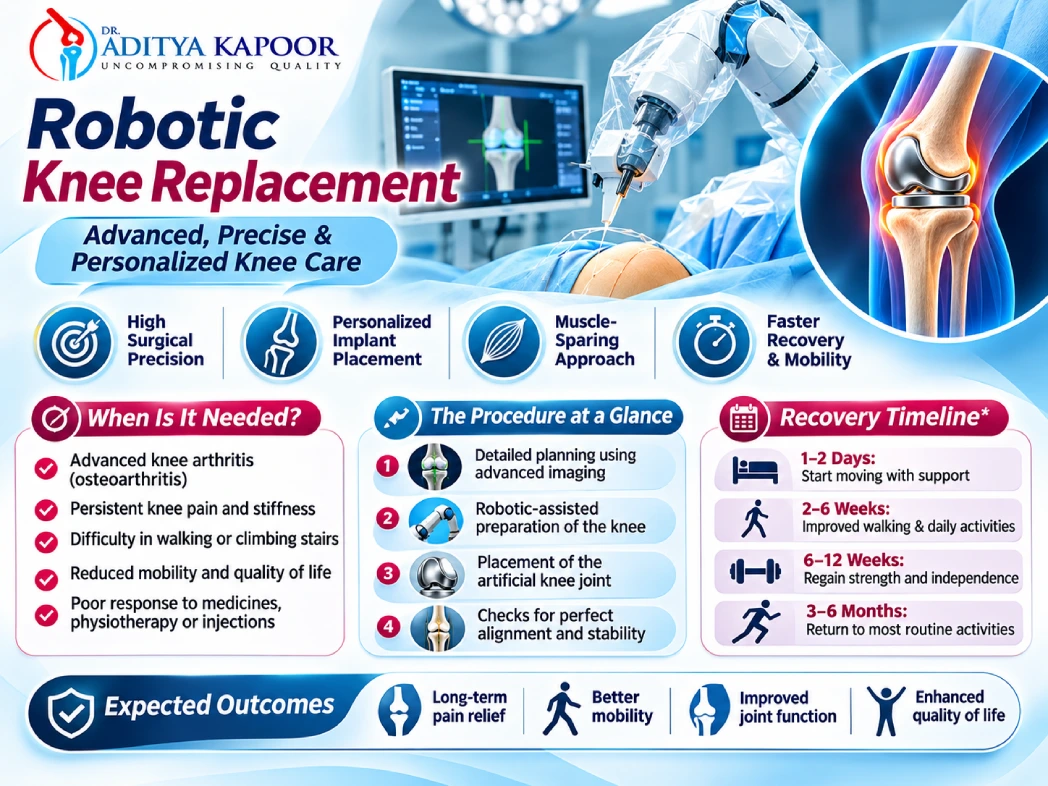
1. What Is Robotic Knee Replacement?
Robotic knee replacement is an orthopedic procedure in which a surgeon uses a robotic-assisted system to plan and perform knee replacement surgery. Damaged joint surfaces are removed and replaced with specially designed artificial components, generally made from medical-grade metal alloys and durable plastic.
Some systems use preoperative CT scans to create a three-dimensional model of the knee. Others use imaging-free mapping during surgery. The objective is to achieve accurate implant positioning and appropriate joint balance while accounting for the patient's anatomy.
2. Why Is Robotic Knee Replacement Needed?
Not every patient with knee pain needs knee replacement. Many knee conditions can be treated without surgery. However, when joint damage becomes severe and conservative treatments no longer provide adequate relief, knee replacement may become an appropriate option.
Osteoarthritis
The most common reason for knee replacement. Cartilage gradually wears away, causing pain, stiffness, and reduced mobility.
Rheumatoid Arthritis
Chronic inflammation can damage cartilage, bone, and surrounding joint structures.
Post-Traumatic Arthritis
Previous fractures, ligament injuries, or other significant knee injuries may contribute to joint degeneration.
Severe Joint Deformity
Advanced arthritis may cause bow-legged or knock-kneed alignment, making walking uncomfortable and difficult.
Persistent Pain and Functional Limitations
Patients with substantial pain despite appropriate nonsurgical treatment may benefit from knee replacement.
The decision to undergo surgery depends on symptoms, examination findings, imaging, overall health, and individual treatment goals. Robotic assistance is one way of performing knee replacement; it does not automatically make surgery necessary.
3. Warning Signs That Knee Replacement May Be Needed
Consider an orthopedic evaluation if knee pain is controlling your daily routine or affecting your independence. Common warning signs include:
- Persistent knee pain during walking or standing.
- Significant stiffness after sitting or resting.
- Difficulty climbing stairs.
- Pain that interrupts sleep.
- Reduced ability to bend or straighten the knee.
- Swelling and progressive joint deformity.
- Difficulty performing routine activities.
- Limited improvement despite appropriate treatment.
4. How Is Robotic Knee Replacement Performed?
The exact procedure varies depending on the robotic system and whether a partial or total knee replacement is performed.
Preoperative Evaluation and Planning
The surgeon examines the knee and reviews appropriate imaging. Some systems use a CT scan to create a three-dimensional model to help plan implant size, positioning, and bone preparation. Other systems generate anatomical information during surgery.
Anaesthesia and Preparation
The operation is usually performed under spinal or general anaesthesia. Regional nerve blocks may also be used to improve postoperative pain control. The knee is cleaned and prepared using sterile techniques.
Assessing the Joint
The surgeon makes an incision over the knee and exposes the damaged joint surfaces. The robotic system helps assess the patient's anatomy and alignment. Depending on the system, soft-tissue balance can also be evaluated.
Removing Damaged Bone and Cartilage
The surgeon uses robotic guidance or a robotic-assisted cutting system to prepare the bone. The objective is to remove the planned amount of damaged tissue while accurately preparing the surfaces for the implants.
Positioning the Artificial Joint
The surgeon places the selected knee replacement components. These typically include metal components attached to the femur and tibia, with a durable plastic insert between them. The kneecap surface may also be treated or resurfaced when clinically appropriate.
Checking Alignment and Stability
The surgeon assesses knee movement, implant positioning, ligament balance, and overall stability. Adjustments may be made when necessary.
Closing the Incision
After confirming satisfactory implant function, the incision is closed and covered with sterile dressings.
5. Potential Advantages of Robotic Knee Replacement
Greater Precision in Planning
Robotic technology can help surgeons achieve planned implant positioning and alignment more consistently.
Personalized Implant Positioning
The surgical plan can be adjusted according to the patient's anatomy and soft-tissue balance.
Controlled Bone Preparation
Some robotic systems use predefined boundaries to guide bone preparation.
Real-Time Surgical Feedback
The surgeon may receive information about alignment, movement, and ligament balance during the operation.
Potential Improvement in Early Recovery
Some studies suggest benefits in certain early recovery measures, but results vary.
6. Pain Management After Robotic Knee Replacement
Some pain, swelling, and stiffness are expected after surgery. Modern pain-management strategies help make recovery more comfortable.
Multimodal Pain Medication
Doctors may prescribe paracetamol, suitable anti-inflammatory medication, and short-term stronger pain relief when required. Medication selection depends on individual health conditions.
Regional Nerve Blocks
An adductor canal block or another appropriate regional technique may help reduce postoperative pain.
Cold Therapy
A wrapped ice pack applied for approximately 15–20 minutes at a time can help reduce swelling and discomfort.
Elevation and Swelling Control
Appropriate positioning, prescribed exercises, and movement can help manage swelling.
Early Physiotherapy
Patients are commonly encouraged to begin approved knee movements and walking exercises soon after surgery.
Rest and Nutrition
Good sleep, hydration, and balanced nutrition support recovery.
7. Recovery After Robotic Knee Replacement
Recovery varies according to age, overall health, muscle strength, surgical complexity, and rehabilitation progress.
8. Expected Outcomes and Implant Longevity
For appropriately selected patients, knee replacement can provide substantial relief from advanced arthritis symptoms.
- Reduced chronic knee pain.
- Improved walking ability.
- Better joint alignment.
- Improved daily functioning.
- Greater independence.
- Increased participation in low-impact activities.
How long does a knee replacement last?
Modern knee replacement implants are designed for long-term use. Large studies suggest that approximately 80–90% of total knee replacements may remain in place after 20 years, although durability varies according to implant type, patient factors, and surgical circumstances.
These figures describe knee replacement outcomes generally, not a proven advantage specific to robotic surgery.
9. Risks and Possible Complications
Like conventional knee replacement, robotic-assisted surgery carries risks. Possible complications include:
- Infection.
- Blood clots.
- Bleeding.
- Persistent pain or stiffness.
- Nerve or blood vessel injury.
- Implant loosening or wear.
- Instability.
- Fracture.
- Need for revision surgery.
Robotic systems may also introduce technology-specific considerations, such as tracking-pin complications or registration errors, depending on the platform. A detailed consultation helps patients understand the benefits and risks.
10. Frequently Asked Questions
Does the robot perform the surgery independently?
No. The orthopedic surgeon controls the procedure, while the robotic system provides planning and guidance.
Is robotic knee replacement completely painless?
No. Some postoperative discomfort is expected, but pain can usually be managed effectively.
Can both knees be replaced using robotic technology?
Yes, in selected patients. Whether both knees should be operated on together or separately depends on medical fitness and individual circumstances.
Can I walk immediately after surgery?
Many patients begin walking with assistance within the first 24 hours, depending on their condition and medical team's advice.
Will I be able to sit cross-legged or squat after surgery?
Deep squatting and cross-legged sitting may remain difficult or may not be recommended, depending on implant design, knee mobility, and surgeon guidance.
Is robotic knee replacement suitable for everyone?
No. Suitability depends on joint damage, bone anatomy, medical conditions, and the availability of appropriate technology.
Expert Robotic Knee Replacement & Joint Care in Hyderabad
Are you struggling with severe knee arthritis, persistent pain, stiffness, or difficulty walking?
Consult Dr. Aditya Kapoor — Orthopaedic Surgeon, Joint Replacement, Arthroscopy & Sports Medicine Specialist in Hyderabad — for a comprehensive evaluation and personalized treatment options, including the suitability of robotic-assisted knee replacement.
Call +91 7799191082 Visit Website