
Loose Body Removal Surgery: Why Is It Needed & How Is It Performed?
Understand the causes of loose bodies, common symptoms, arthroscopic removal, and what to expect during recovery.
Does your knee suddenly lock while walking? Do you experience painful clicking, swelling, or a feeling that something is moving inside your joint?
These symptoms could be caused by loose bodies within the joint. Small fragments of cartilage or bone can move freely inside a joint, sometimes interfering with normal movement.
Although some loose bodies cause no problems, others can trigger inflammation, repeated pain, and episodes of joint locking. When treatment is necessary, arthroscopic removal offers a minimally invasive approach.
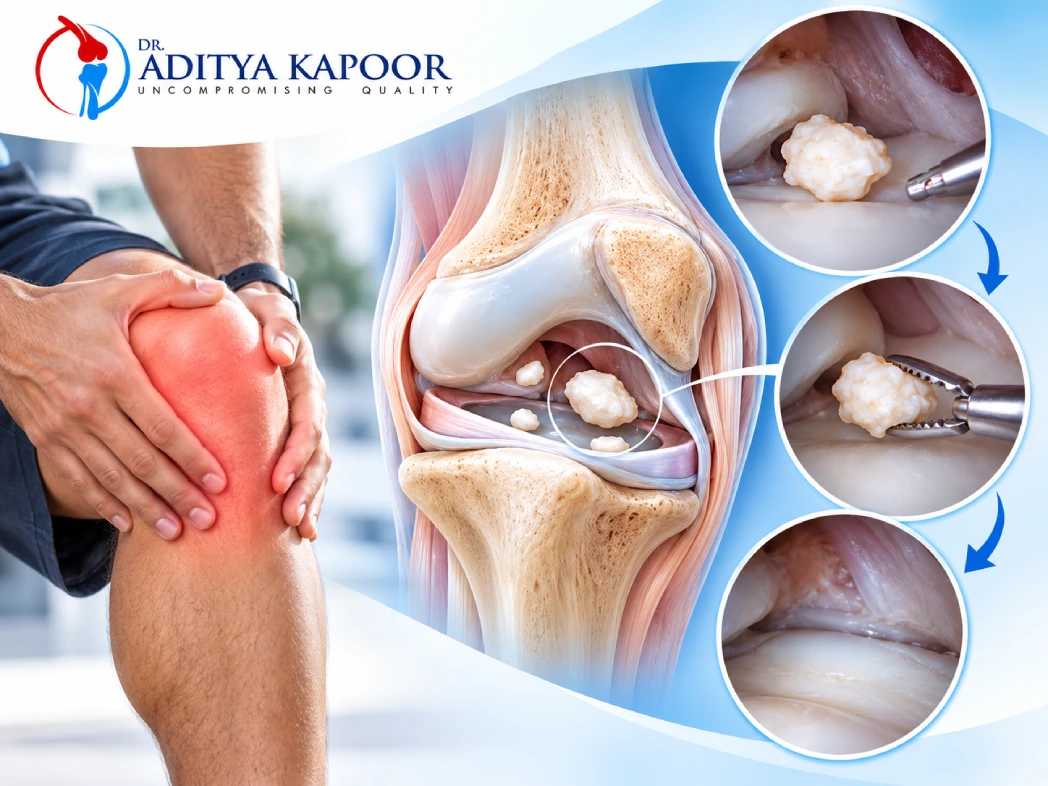
What Are Loose Bodies in a Joint?
A healthy joint contains smooth cartilage that allows bones to move against each other with minimal friction.
Sometimes, a small piece of cartilage, bone, or a combination of both becomes detached and moves freely within the joint space. This fragment is called a loose body.
Loose bodies can occur in several joints, including the knee, elbow, shoulder, hip, and ankle. However, they are commonly encountered in the knee.
It may remain unnoticed for some time, but if it becomes trapped between moving joint surfaces, it can cause discomfort or temporarily block movement.
What Causes Loose Bodies in the Joints?
Loose bodies can develop for several reasons. Identifying the underlying cause is important because removing the loose fragment may not completely address the original joint problem.
Joint Injuries
A fall, sports injury, or direct impact may cause a piece of cartilage or bone to break away from the joint surface.
Osteoarthritis
As joint cartilage gradually wears down, fragments may become detached and remain within the joint.
Osteochondritis Dissecans
This condition affects the bone beneath the cartilage. In some cases, a section of bone and cartilage can separate and become a loose fragment.
Synovial Chondromatosis
This relatively uncommon condition causes cartilage nodules to develop within the joint lining. Some nodules eventually detach and become loose bodies.
Previous Joint Damage
Old fractures, cartilage injuries, or other joint disorders may also contribute to the formation of loose fragments.
What Are the Symptoms of Loose Bodies?
Have you ever felt that your knee suddenly catches or refuses to straighten completely? That sensation may be an important clue.
Joint Locking
The joint suddenly becomes stuck during movement, sometimes preventing you from bending or straightening it.
Clicking or Catching
A noticeable sensation may occur when bending or straightening the affected joint.
Pain
Discomfort may worsen with movement or physical activity, especially when the fragment becomes trapped.
Swelling
Repeated irritation can lead to inflammation and fluid accumulation inside the joint.
Restricted Movement
You may experience difficulty fully bending or straightening the affected joint.
Intermittent Symptoms
Pain or locking may come and go as the fragment changes position inside the joint.
Not every clicking joint contains a loose body. Meniscus tears, ligament injuries, and cartilage disorders can produce similar symptoms. A proper orthopedic examination is necessary to determine the cause.
Why Is Loose Body Removal Needed?
Does every loose body inside a joint need to be surgically removed? Not necessarily.
Small fragments that do not cause pain, locking, or functional limitations may sometimes be monitored. However, surgery may be recommended when a loose body repeatedly interferes with joint movement or causes significant symptoms.
When Might Surgery Be Necessary?
Repeated Joint Locking
A loose fragment can become trapped between joint surfaces, preventing normal movement.
Persistent Pain and Swelling
Repeated irritation may contribute to inflammation and discomfort.
Reduced Joint Mobility
A loose body may interfere with bending, straightening, or performing everyday activities.
Mechanical Symptoms
Difficulty walking, climbing stairs, exercising, or participating in sports may justify surgical treatment.
Associated Joint Damage
If imaging reveals a detached osteochondral fragment or another treatable joint injury, surgery may help address both problems.
Remove the mechanical obstruction, relieve symptoms, and improve joint movement.
Importantly, loose body removal does not reverse existing arthritis or guarantee prevention of future cartilage damage.
How Is Loose Body Removal Surgery Performed?
Loose body removal is commonly performed using arthroscopy, a minimally invasive surgical technique.
Instead of making a large incision, the orthopedic surgeon uses a small camera and specialized instruments to examine and treat the joint.
Anaesthesia and Preparation
Depending on the joint, the patient's health, and the procedure, surgery may be performed under general, regional, or occasionally local anaesthesia.
The affected joint is cleaned and prepared under sterile conditions.
Creating Small Incisions
The surgeon makes small openings around the affected joint. An arthroscope, a thin instrument with a camera, is inserted through one opening.
The camera displays detailed images of the joint on a monitor.
Locating the Loose Bodies
The surgeon carefully examines the joint to identify loose fragments.
The cartilage, ligaments, menisci, or other relevant structures may also be assessed for associated damage.
Removing the Fragments
Specialized instruments, such as graspers or suction devices, are introduced through another small opening.
The surgeon retrieves the loose bodies while taking care to protect the surrounding joint structures.
If several fragments are present, each accessible fragment is identified and removed.
Treating Associated Problems
Depending on the findings, the surgeon may also address damaged cartilage or other abnormalities.
Additional procedures are performed only when clinically appropriate and agreed upon as part of the treatment plan.
Closing the Incisions
After the joint has been examined and the necessary treatment completed, the instruments are removed. The small incisions are closed and covered with sterile dressings.
Many uncomplicated arthroscopic loose body removals are performed as day-care procedures.
How Long Does Surgery Take?
An isolated procedure may take approximately 30–60 minutes. However, the duration varies depending on the joint, the number and location of fragments, and any additional treatment required.
Pain Management After Loose Body Removal
Mild to moderate pain, swelling, and stiffness are common during the initial recovery period. Fortunately, postoperative discomfort can usually be managed effectively.
Medication
Your surgeon may recommend paracetamol, suitable anti-inflammatory medication, or other short-term pain relief. Take medication only as prescribed.
Cold Therapy
Applying a wrapped ice pack for 15–20 minutes at a time can help reduce swelling and discomfort. Avoid direct contact between ice and the skin.
Rest and Elevation
For knee or ankle procedures, elevating the operated leg when resting may help reduce swelling.
Gentle Movement
Your surgeon or physiotherapist may recommend early, controlled movements to prevent stiffness and encourage circulation.
Physiotherapy
Rehabilitation exercises help restore mobility, muscle strength, and confidence in joint movement.
Seek medical advice if you experience increasing pain, fever, wound discharge, worsening redness, or unusual swelling.
Severe calf pain or swelling, chest pain, or sudden breathlessness requires urgent medical assessment.
Recovery After Loose Body Removal: What Is the Timeline?
Recovery depends on which joint was treated, the extent of underlying damage, and whether additional procedures were performed.
For an uncomplicated arthroscopic knee loose body removal, recovery may follow this general pattern.
Rest and Initial Healing
Mild swelling and discomfort are expected. Some patients can walk with weight-bearing as tolerated soon after surgery, while others may require temporary crutches.
Follow your surgeon's instructions regarding movement and weight-bearing.
Returning to Basic Activities
Pain and swelling generally begin to improve. Patients may gradually resume light daily activities, depending on comfort and the nature of their work.
Wound care and gentle exercises remain important.
Improving Strength and Mobility
Physiotherapy may focus on restoring range of motion, muscle strength, balance, and normal walking patterns.
Many patients progressively return to routine activities during this period.
Returning to More Demanding Activities
Patients recovering from an isolated, uncomplicated procedure may gradually resume more demanding exercise when strength and movement have recovered.
Athletic activities should restart only after appropriate medical clearance.
If cartilage repair, microfracture, or another major procedure was performed at the same time, rehabilitation may take several months and require restricted weight-bearing.
What Are the Expected Outcomes of Loose Body Removal?
For patients whose symptoms are caused by a loose fragment, arthroscopic removal can provide meaningful relief.
Reduced Mechanical Locking
Removing the troublesome fragment may reduce repeated catching and locking sensations.
Improved Joint Mobility
Removing the mechanical obstruction can help improve joint movement.
Less Pain and Swelling
Removing an irritating fragment may reduce irritation-related pain and swelling.
Better Daily Function
Patients may experience greater comfort during everyday activities and rehabilitation.
Why Does the Overall Joint Condition Matter?
A patient with an isolated loose body and otherwise healthy cartilage may experience substantial improvement.
A patient with advanced osteoarthritis may continue to experience pain even after the fragment has been removed.
Are There Any Risks?
Although arthroscopy is generally considered minimally invasive, it is still surgery. Possible complications include:
- Infection.
- Bleeding.
- Blood clots.
- Joint stiffness.
- Nerve or blood vessel injury.
- Persistent symptoms.
In some conditions, such as synovial chondromatosis, loose bodies may recur.
Your surgeon can explain the expected benefits and risks based on your diagnosis and the overall condition of your joint.
Frequently Asked Questions About Loose Body Removal
1. Can Loose Bodies Disappear Without Surgery?
Some small fragments may remain asymptomatic, but larger bone or cartilage fragments generally do not simply dissolve. Treatment depends on symptoms and the underlying condition.
2. Is Loose Body Removal a Major Operation?
Isolated arthroscopic removal is usually a relatively small procedure, but its complexity depends on the joint and associated damage.
3. Can I Walk Immediately After Knee Loose Body Removal?
Some patients can bear weight soon after an uncomplicated procedure. Others may need crutches or restrictions, particularly if additional cartilage treatment was performed.
4. Will the Loose Bodies Come Back?
Recurrence is possible, particularly when the underlying condition continues to produce fragments.
5. Can I Return to Sports After Surgery?
Many patients return to sports after rehabilitation. The timing depends on joint healing, muscle strength, mobility, and the presence of other injuries.
When Should You Consult an Orthopedic Specialist?
If you experience repeated joint locking, painful clicking, swelling, or restricted movement, an orthopedic assessment can help identify the cause.
Your doctor may recommend X-rays, MRI, or other imaging to evaluate the joint.
Not every loose body is visible on a standard X-ray, particularly when the fragment consists mainly of cartilage.
Early diagnosis helps determine whether observation, physiotherapy, or surgical removal is appropriate.
Don't Let Joint Locking Restrict Your Movement
Living with unpredictable joint locking or recurring pain can make even simple activities frustrating.
When a loose body is responsible for these symptoms, arthroscopic removal may offer effective relief with relatively small incisions and a structured recovery program.
The key is identifying the underlying problem and choosing treatment that addresses both the symptoms and the overall health of the joint.
Expert Arthroscopy & Joint Care in Hyderabad
Are you experiencing painful joint locking, clicking, swelling, or difficulty moving your knee, shoulder, or another joint?
Consult Dr. Aditya Kapoor — Orthopedic Surgeon, Joint Replacement, Arthroscopy & Sports Medicine Specialist in Hyderabad — for personalized evaluation and treatment of loose bodies, cartilage injuries, sports-related joint problems, and other orthopedic conditions.
Get expert guidance to understand your condition and explore the most appropriate treatment options.
Call +91 7799191082This page provides general educational information and does not replace a professional medical assessment. Diagnosis, treatment, and rehabilitation should be individualized by your treating orthopedic specialist.
