
Bioscaffold Fillers for Cartilage Repair: An Advanced Approach
Is persistent knee pain, swelling, or stiffness preventing you from enjoying everyday activities? Specially designed biological scaffolds may help support the repair of selected damaged cartilage areas.
Sports injuries, accidents, and certain joint conditions can damage cartilage. Unlike skin or muscle, cartilage has a limited ability to heal naturally.
Explore Treatment Options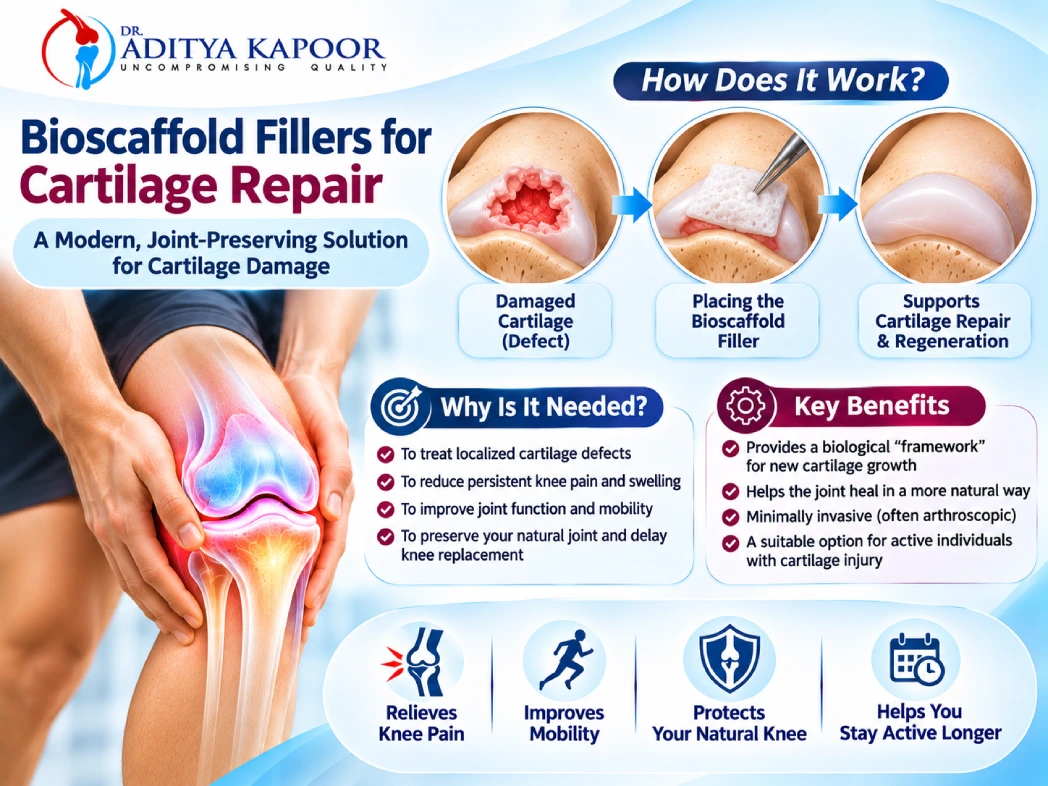
1. What Are Bioscaffold Fillers for Cartilage Repair?
Bioscaffolds are specially designed materials that provide a supportive framework for tissue repair. Think of a bioscaffold as a temporary foundation placed within a damaged cartilage area.
Just as a framework supports construction, a bioscaffold can help stabilize biological materials and provide an environment in which repair tissue may develop.
Materials Used in Bioscaffolds
Collagen
A natural structural protein found in connective tissues.
Hyaluronic Acid
A substance naturally present in joints.
Biodegradable Polymers
Materials designed to gradually break down.
Composite Biomaterials
Combinations developed for specific cartilage repair applications.
One established scaffold-assisted technique is Autologous Matrix-Induced Chondrogenesis (AMIC), which combines bone marrow stimulation with a biological membrane.
Other scaffold-based techniques may incorporate cartilage cells, bone marrow-derived materials, or specialized grafts.
2. Why Is Cartilage Repair Necessary?
Cartilage acts as a smooth protective surface that allows bones to glide against each other. When cartilage becomes damaged, the joint surface may become uneven, increasing stress on the surrounding tissues.
Sports Injuries
Sudden twisting, jumping, or direct impact may damage cartilage.
Accidents and Falls
Trauma can affect cartilage and the underlying bone.
Osteochondral Lesions
Damage may involve cartilage and its supporting bone.
Previous Ligament Injuries
Cartilage damage may occur alongside ACL tears or joint instability.
Repeated Joint Stress
Excessive loading can affect vulnerable cartilage.
Because cartilage lacks a direct blood supply, its ability to repair itself is limited. Some injuries remain relatively harmless, while others cause persistent symptoms and require specialized treatment.
3. Symptoms of Cartilage Damage
Cartilage problems may cause discomfort during walking, running, or climbing stairs.
- Persistent joint pain.
- Swelling after physical activity.
- Joint stiffness.
- Clicking or catching sensations.
- Occasional locking.
- Difficulty squatting or climbing stairs.
- Reduced movement and sporting performance.
4. Why Are Bioscaffold Fillers Needed?
Does every cartilage injury require a bioscaffold procedure? No. Many patients improve with physiotherapy, activity modification, and other nonsurgical treatments.
Bioscaffold-assisted repair may be considered when a localized cartilage defect continues causing symptoms despite appropriate conservative treatment.
Localized Cartilage Defects
Selected focal cartilage injuries may benefit from scaffold-supported repair.
Persistent Pain and Swelling
Patients experiencing ongoing symptoms despite rehabilitation may require surgical evaluation.
Sports-Related Cartilage Injuries
Active individuals with suitable cartilage defects may be candidates for joint-preserving procedures.
Selected Osteochondral Lesions
Scaffolds may form part of a broader treatment approach when both cartilage and underlying bone are damaged.
Joint Preservation
The treatment may help manage localized cartilage damage while retaining the natural joint.
Who may not be an ideal candidate?
Bioscaffold-assisted repair is generally not intended to reverse widespread, advanced osteoarthritis. Other factors that may affect suitability include:
- Significant joint malalignment.
- Untreated ligament instability.
- Extensive meniscus damage.
- Severe underlying bone disease.
The treatment must be selected according to the specific defect and the patient's overall joint condition.
5. How Is Bioscaffold Cartilage Repair Performed?
Anaesthesia and Preparation
The procedure is performed under appropriate anaesthesia, commonly general or regional anaesthesia. The affected joint is prepared using sterile techniques.
Examining the Cartilage Defect
The surgeon examines the joint using an arthroscope or an open surgical approach. The cartilage injury is assessed for size, depth, stability, and location.
Preparing the Damaged Area
Loose or unstable cartilage is carefully removed. The surgeon prepares the defect to create a suitable surface for treatment.
Stimulating the Bone Marrow
In AMIC, small openings are created in the underlying bone using a microfracture or drilling technique. This allows blood and marrow-derived cells to enter the damaged area. The resulting biological clot contributes to the repair process.
Placing the Bioscaffold
A specially prepared biological membrane is trimmed to fit the defect. The scaffold is positioned over the treated area and secured using an appropriate technique, sometimes involving fibrin glue or sutures. It helps stabilize the repair clot and provides a supportive framework for tissue development.
Closing and Protecting the Joint
After confirming the scaffold's position, the surgeon closes the incisions. Crutches, a brace, or restricted weight-bearing may be recommended to protect the healing area.
6. Pain Management After Bioscaffold Cartilage Repair
Some discomfort, swelling, and stiffness are expected during the initial postoperative period. Pain can usually be managed with a structured recovery plan.
Prescribed Medication
Your surgeon may recommend paracetamol or other suitable pain-relieving medication. Anti-inflammatory medicines should only be used when approved, as recommendations may vary according to the cartilage repair technique.
Cold Therapy
Applying a wrapped ice pack for approximately 15–20 minutes can help reduce swelling and discomfort.
Elevation
Keeping the operated leg elevated while resting may help control swelling.
Protected Weight-Bearing
Crutches may be required to avoid excessive pressure on the healing cartilage.
Physiotherapy
Gentle, controlled exercises help maintain movement, prevent stiffness, and gradually restore muscle strength.
7. Recovery After Bioscaffold Cartilage Repair
Although surgical wounds may heal relatively quickly, developing repair tissue needs several months to mature. The following is a general rehabilitation outline for scaffold-assisted knee cartilage surgery.
8. Expected Outcomes of Bioscaffold Cartilage Repair
For appropriately selected patients, bioscaffold-assisted cartilage repair can provide meaningful improvements in pain and joint function.
- Reduced activity-related pain.
- Improved joint mobility.
- Less recurring swelling.
- Better tolerance for daily activities.
- Support for localized cartilage repair.
- Preservation of the natural joint.
How successful is bioscaffold cartilage repair?
Clinical studies of AMIC have reported improvements in pain and functional scores among patients with selected knee cartilage defects. However, outcomes vary according to the scaffold, surgical technique, defect characteristics, and patient selection.
Research is still developing, particularly regarding long-term durability and comparisons between different scaffold materials.
What factors influence the results?
- Size and location of the defect.
- Condition of the underlying bone.
- Joint alignment.
- Ligament stability.
- Body weight and activity demands.
- Adherence to rehabilitation.
9. Risks and Possible Complications
Although scaffold-assisted procedures can be minimally invasive, they remain surgical treatments. Possible complications include:
- Infection or bleeding.
- Blood clots.
- Joint stiffness.
- Persistent pain or swelling.
- Scaffold displacement or incomplete integration.
- Inadequate repair tissue formation.
- Continued cartilage degeneration.
- Need for additional surgery.
Your surgeon should explain the potential benefits and limitations before treatment.
10. Frequently Asked Questions About Bioscaffold Fillers
Are bioscaffold fillers the same as knee replacement?
No. Bioscaffold-assisted cartilage repair treats selected localized defects while preserving the natural joint. Knee replacement involves artificial joint components.
Do bioscaffolds contain stem cells?
Not necessarily. Some scaffolds are cell-free, while others are combined with cartilage cells or marrow-derived biological materials.
Can bioscaffolds regenerate completely normal cartilage?
Not reliably. They support tissue repair, but the resulting tissue may differ from healthy native cartilage.
Is bioscaffold repair better than microfracture?
Some studies suggest advantages for selected patients, but no single technique is best for every cartilage defect.
Can I return to sports after treatment?
Many patients return to recreational activities following rehabilitation. Timing depends on healing, strength, joint function, and medical clearance.
Expert Cartilage Repair & Joint Preservation in Hyderabad
Are you experiencing persistent knee pain, cartilage damage, recurring swelling, or difficulty returning to sports?
Consult Dr. Aditya Kapoor — Orthopaedic Surgeon, Joint Replacement, Arthroscopy & Sports Medicine Specialist in Hyderabad — for personalized evaluation of cartilage injuries, osteochondral lesions, ligament injuries, and suitable joint-preserving treatment options.
Book Your Consultation Call +91 7799191082