
Robotic Hip Replacement: What Can You Expect During Recovery?
Are you struggling with persistent hip pain, stiffness, or difficulty walking? Robotic-assisted hip replacement may offer a more personalized surgical approach to relieving pain and restoring mobility.
For people living with advanced hip arthritis, simple activities such as climbing stairs, getting out of a chair, or sleeping comfortably can become difficult. When conservative treatments no longer provide adequate relief, surgery may be considered.
Call +91 7799191082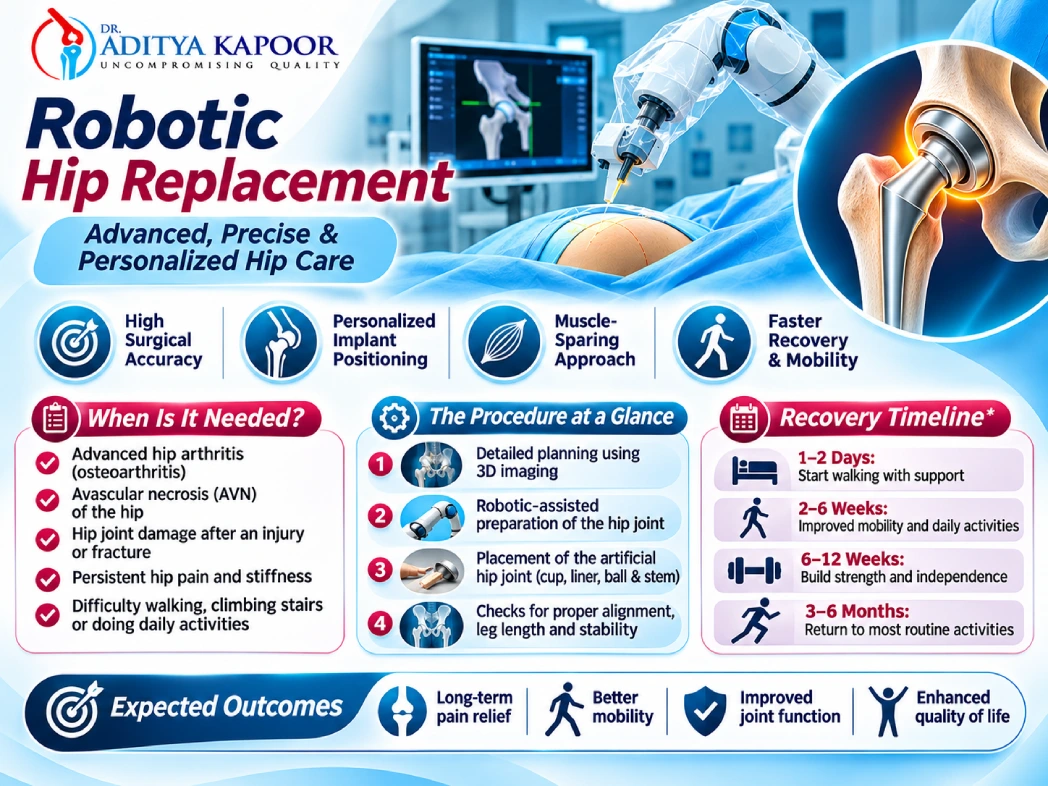
1. What Is Robotic Hip Replacement?
Robotic hip replacement is an orthopedic procedure in which a surgeon uses a robotic-assisted system to plan and perform hip replacement surgery.
The hip is a ball-and-socket joint. The rounded head of the femur fits into a socket in the pelvis called the acetabulum. Healthy cartilage allows these surfaces to move smoothly. When cartilage becomes severely damaged, the bones may rub against each other, causing pain, stiffness, and restricted movement.
During total hip replacement, the damaged joint surfaces are replaced with artificial components. These generally include:
- An artificial socket placed inside the pelvis.
- A durable liner inside the socket.
- A metal stem inserted into the thigh bone.
- An artificial ball attached to the stem.
The goal is to achieve accurate implant placement while considering the patient's individual anatomy.
2. Why Is Robotic Hip Replacement Needed?
Not everyone with hip pain needs hip replacement surgery. Many hip conditions can be managed without surgery. However, when joint damage becomes severe and conservative treatments no longer provide adequate relief, hip replacement may become an appropriate option.
Hip Osteoarthritis
One of the most common reasons for hip replacement. Protective cartilage gradually wears away, making movement painful and reducing joint flexibility.
Avascular Necrosis (AVN)
Occurs when the blood supply to part of the femoral head becomes disrupted. In advanced stages, the bone may collapse, causing severe pain and joint damage.
Rheumatoid Arthritis
Chronic joint inflammation can damage cartilage and bone, leading to progressive pain and stiffness.
Post-Traumatic Arthritis
Previous hip fractures, dislocations, or significant injuries may eventually lead to joint degeneration.
Certain Hip Fractures
Hip replacement may be recommended for selected patients with fractures involving the femoral neck.
Severe Hip Deformity or Degeneration
Developmental hip conditions and other structural abnormalities may contribute to advanced joint damage.
3. Warning Signs That Hip Replacement May Be Needed
Consider an orthopedic assessment if hip pain is interfering with daily activities and independence. Common warning signs include:
- Persistent pain in the groin, hip, thigh, or buttock.
- Difficulty walking or standing for extended periods.
- Stiffness after sitting or resting.
- Pain while climbing stairs.
- Difficulty putting on socks or shoes.
- Reduced hip movement.
- Pain that disturbs sleep.
- Limping or reduced walking endurance.
- Limited improvement despite appropriate nonsurgical treatment.
4. How Is Robotic Hip Replacement Performed?
The exact technique depends on the robotic platform, implant system, and surgical approach.
Preoperative Evaluation and Planning
The surgeon reviews the patient's medical history, physical examination, and imaging. Some robotic systems use a CT scan to create a three-dimensional model of the hip, helping plan the size, orientation, and position of the artificial components. Other systems use different imaging or intraoperative mapping techniques.
Anaesthesia and Preparation
The procedure is performed under spinal or general anaesthesia. The patient is positioned appropriately, and the surgical area is prepared using sterile techniques.
Accessing the Hip Joint
The surgeon makes an incision to access the damaged hip. The incision location depends on the surgical approach, which may be posterior, lateral, or anterior. Robotic assistance does not necessarily mean the operation is minimally invasive or muscle-sparing.
Removing the Damaged Joint Surfaces
The damaged femoral head is removed. The surgeon then prepares the pelvic socket to receive the artificial cup. The robotic system may assist with guiding bone preparation and confirming the planned socket position.
Placing the Artificial Components
The surgeon implants the artificial socket and liner. The femur is prepared for the stem, and an artificial ball is attached. Depending on the robotic system, guidance may be available for selected stages of implant placement.
Checking Leg Length and Joint Stability
The surgeon assesses the hip's range of motion, stability, and leg length. Robotic feedback may help evaluate implant positioning and planned biomechanics.
Closing the Incision
Once the components are securely positioned, the surgical wound is closed and covered with sterile dressings.
5. Potential Advantages of Robotic Hip Replacement
Improved Implant Positioning Accuracy
Robotic guidance can help surgeons achieve planned component positioning more consistently.
Personalized Surgical Planning
The procedure can be planned according to the patient's anatomy and the selected implant system.
Better Assessment of Hip Biomechanics
Some systems help surgeons evaluate leg length, hip offset, and component positioning.
Controlled Bone Preparation
Certain robotic systems provide guidance or boundaries during bone preparation.
Real-Time Feedback
The surgeon may receive information that helps refine implant placement during surgery.
6. Pain Management After Robotic Hip Replacement
Some postoperative pain, swelling, and discomfort are expected, especially during the first few days. Modern pain-management techniques can help improve comfort and support early mobility.
Multimodal Pain Medication
Doctors may prescribe a combination of paracetamol, suitable anti-inflammatory medicines, and short-term stronger pain relief when necessary. Medication choices depend on the patient's medical history.
Regional Anaesthesia and Local Pain Relief
Spinal anaesthesia, local infiltration, or selected nerve blocks may help manage pain during and after surgery.
Cold Therapy
Applying a wrapped ice pack for approximately 15–20 minutes at a time may help reduce swelling and discomfort.
Early Mobilization
Walking with assistance soon after surgery can help restore confidence and reduce certain postoperative complications.
Physiotherapy
Supervised exercises help improve walking patterns, muscle strength, and hip movement.
Rest and Nutrition
Adequate rest, hydration, and balanced nutrition support recovery.
7. Recovery After Robotic Hip Replacement
Recovery varies according to age, general health, muscle strength, surgical approach, and rehabilitation progress.
8. Expected Outcomes and Artificial Hip Longevity
For appropriately selected patients, total hip replacement is one of the most effective orthopedic procedures for relieving pain caused by advanced joint disease.
Potential benefits include:
- Significant reduction in chronic hip pain.
- Improved walking ability.
- Better hip movement.
- Greater independence in daily activities.
- Improved sleep and comfort.
- Increased participation in low-impact exercise.
- Better overall quality of life.
How long does an artificial hip last?
Modern hip replacement implants are designed for long-term use. Large registry-based studies suggest that approximately 90% of contemporary total hip replacements may remain in place at 15 years, although longevity depends on implant type, patient factors, and other circumstances. Many implants last considerably longer.
These outcomes describe hip replacement generally and should not be interpreted as a proven durability advantage of robotic surgery.
What influences long-term success?
- Implant selection and positioning.
- Bone quality.
- Age and activity level.
- Body weight.
- General health.
- Surgical technique.
- Rehabilitation adherence.
- Avoidance of complications.
9. Risks and Possible Complications
Like conventional hip replacement, robotic-assisted surgery carries risks. Possible complications include:
- Infection.
- Blood clots.
- Bleeding.
- Hip dislocation.
- Leg-length difference.
- Nerve or blood vessel injury.
- Fracture.
- Implant loosening or wear.
- Persistent pain.
- Need for revision surgery.
Some robotic systems also involve tracking pins, which introduce additional risks such as pin-site complications. A detailed consultation helps patients understand the expected benefits and potential risks.
10. Frequently Asked Questions
Does the robot perform hip replacement independently?
No. The orthopedic surgeon performs and controls the operation, while the robotic system assists with planning and selected surgical steps.
Is robotic hip replacement completely painless?
No. Some postoperative discomfort is expected, but pain can usually be managed effectively.
Can I walk immediately after surgery?
Many patients begin walking with assistance within the first 24 hours, depending on their medical condition and surgical team's instructions.
Is robotic hip replacement suitable for everyone?
No. Suitability depends on the patient's anatomy, medical condition, surgical requirements, and available technology.
Can I sit cross-legged or squat after surgery?
These activities depend on hip movement, implant stability, surgical approach, and the surgeon's recommendations. Deep bending or twisting may be restricted during early recovery.
Can I return to sports after hip replacement?
Many patients return to low-impact activities. High-impact sports require individualized assessment because they may increase stress on the implant.
Expert Hip Replacement & Joint Care in Hyderabad
Are you struggling with severe hip arthritis, avascular necrosis, persistent hip pain, or difficulty walking?
Consult Dr. Aditya Kapoor — Orthopedic Surgeon, Joint Replacement, Arthroscopy & Sports Medicine Specialist in Hyderabad — for a comprehensive evaluation of hip disorders and personalized treatment options, including the suitability of robotic-assisted hip replacement.
Call +91 7799191082 Visit Website