
Autologous Cartilage Implantation (ACI): Procedure, Recovery & Outcomes
Can damaged knee cartilage be repaired using cells taken from your own body? Autologous Chondrocyte Implantation (ACI) is an advanced cartilage restoration technique designed to treat selected joint injuries and help patients regain comfortable movement.
If knee pain, recurring swelling, or difficulty climbing stairs and returning to sports is affecting your life, a cartilage injury may be one possible cause.
Call +91 7799191082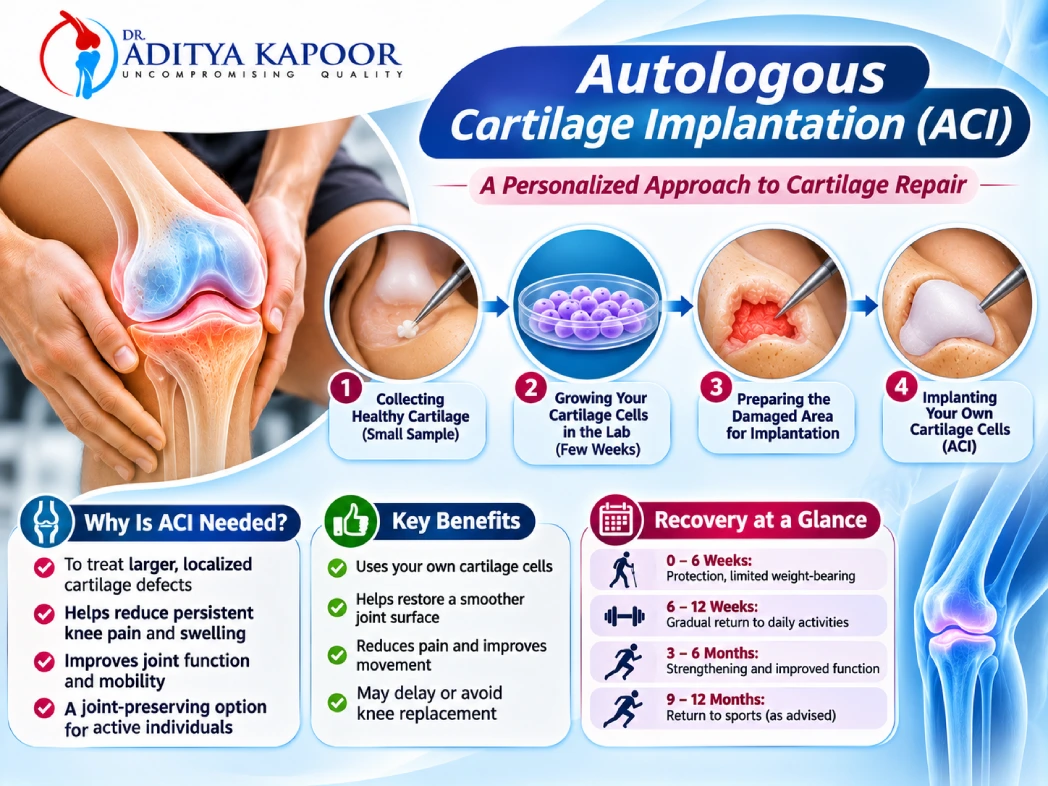
1. What Is Autologous Cartilage Implantation?
Autologous Chondrocyte Implantation is a surgical technique used to treat selected areas of damaged articular cartilage, particularly in the knee.
The word autologous means that the cells come from the patient's own body. Chondrocytes are specialized cells responsible for maintaining cartilage.
During ACI, a surgeon collects a small sample of healthy cartilage from a relatively low-load area of the joint. The cartilage cells are isolated and multiplied in a specialized laboratory. Once sufficient cells are available, they are implanted into the damaged area during a second procedure.
The objective is to encourage the formation of repair tissue, reduce symptoms, and improve joint function. However, the newly formed tissue may not be identical to the original healthy cartilage.
2. Why Is Cartilage Repair Necessary?
The ends of the bones inside a joint are covered with smooth cartilage, allowing movement with minimal friction. When cartilage becomes damaged, the underlying bone may experience abnormal stress, leading to pain, swelling, and difficulty moving.
Sports Injuries
Twisting, jumping, pivoting, or direct impact can damage joint cartilage.
Falls and Accidents
Trauma may affect the surface of the joint.
Osteochondral Injuries
Damage may involve both cartilage and the underlying bone.
Previous Ligament Injuries
Cartilage damage may occur alongside ACL or other joint injuries.
Repetitive Stress
Repeated loading can affect an already vulnerable joint.
Some cartilage defects remain stable, while others cause persistent symptoms. Because cartilage has a limited natural healing capacity, larger symptomatic defects may require specialized treatment.
3. Symptoms of Cartilage Damage
Cartilage injuries can cause discomfort during activity, even when the knee feels reasonably comfortable at rest.
- Persistent or recurring knee pain.
- Swelling after physical activity.
- Joint stiffness.
- Clicking or catching sensations.
- Difficulty squatting or climbing stairs.
- Restricted movement.
- Reduced sporting performance.
4. Why Is ACI Needed?
Does every cartilage injury require ACI surgery? No. Many cartilage injuries can be managed with physiotherapy, activity modification, and other nonsurgical treatments.
ACI is generally considered when a localized cartilage defect continues causing symptoms despite appropriate conservative care.
Larger, Localized Cartilage Defects
ACI may be suitable for selected full-thickness cartilage defects, particularly when the surrounding joint remains relatively healthy.
Persistent Pain and Swelling
Patients who continue experiencing symptoms despite rehabilitation may require surgical evaluation.
Sports-Related Cartilage Damage
Active individuals with suitable cartilage injuries may benefit from joint-preserving treatment.
Previous Unsuccessful Cartilage Treatment
ACI may be considered in selected patients whose earlier cartilage procedures have not provided adequate improvement.
Joint Preservation
For suitable patients, ACI may help treat a focal defect while retaining the natural joint.
Who may not be an ideal candidate?
ACI is generally unsuitable for widespread, advanced osteoarthritis. Other factors requiring assessment include:
- Significant joint malalignment.
- Untreated ligament instability.
- Extensive meniscus damage.
- Certain inflammatory joint conditions.
- Advanced degeneration affecting multiple joint surfaces.
Some associated problems can be corrected during the treatment plan. The goal is to repair a suitable cartilage defect, not to reverse every form of arthritis.
5. How Is Autologous Cartilage Implantation Performed?
ACI is typically a two-stage procedure. The initial operation collects a cartilage sample, while the later operation implants the cultured cells.
Arthroscopic Examination
The surgeon examines the knee using an arthroscope, a small camera inserted through a tiny incision. The cartilage defect is assessed for size, depth, location, and suitability for treatment.
Collecting Healthy Cartilage
A small cartilage sample is taken from a relatively low-load area of the joint and sent to a specialized laboratory.
Growing Cartilage Cells
Chondrocytes are isolated from the sample and multiplied under controlled laboratory conditions. This process usually takes several weeks.
Preparing the Damaged Area
During the second operation, the surgeon prepares the cartilage defect by removing unstable tissue while preserving appropriate surrounding structures.
Implanting the Cells
The implantation method depends on the technique. In traditional ACI, cultured cells are introduced beneath a covering membrane. In MACI, the cells are already seeded onto a collagen membrane, which is trimmed to fit the defect and secured in position.
Protecting the Repair
The incision is closed and the knee is protected using the recommended rehabilitation protocol. Crutches or a brace may be required.
6. Pain Management After ACI
Some postoperative pain, swelling, and stiffness are expected, especially after the implantation procedure. Discomfort can usually be managed through a planned approach.
Prescribed Medication
Your surgeon may recommend paracetamol or other suitable pain-relieving medication. Anti-inflammatory medicines should be used only when approved, as recommendations vary between cartilage repair protocols.
Cold Therapy
Applying a wrapped ice pack for approximately 15–20 minutes may help reduce swelling and discomfort.
Elevation
Keeping the operated leg elevated while resting may help control swelling.
Protected Weight-Bearing
Crutches are often required to prevent excessive loading of the healing cartilage.
Physiotherapy
Controlled rehabilitation helps maintain knee movement, reduce stiffness, and gradually restore muscle strength.
7. Recovery After ACI: How Long Does It Take?
Cartilage implantation requires patience because the newly developing repair tissue needs time to mature. Recovery depends on the defect's location, size, associated procedures, and the surgeon's protocol.
8. Expected Outcomes of ACI
For appropriately selected patients, ACI can provide meaningful improvements in pain and knee function.
- Reduced pain during daily activities.
- Improved joint movement.
- Less activity-related swelling.
- Better exercise tolerance.
- Treatment of selected larger cartilage defects.
- Preservation of the natural knee joint.
How successful is ACI?
Clinical studies have reported encouraging medium- and long-term outcomes, with many patients experiencing sustained improvement after treatment. However, success rates vary according to defect characteristics, surgical technique, patient selection, and the definition of treatment success.
What influences the results?
- Size and location of the cartilage defect.
- Condition of the underlying bone.
- Joint alignment.
- Ligament and meniscus health.
- Age and activity requirements.
- Previous knee surgery.
- Adherence to rehabilitation.
9. Risks and Possible Complications
Like any orthopedic operation, ACI carries risks. Possible complications include:
- Infection or bleeding.
- Blood clots.
- Joint stiffness.
- Persistent pain or swelling.
- Excessive growth of repair tissue.
- Failure of the implanted cartilage.
- Graft detachment or incomplete integration.
- Need for additional surgery.
Your surgeon should explain the potential benefits, limitations, and risks before treatment.
10. Frequently Asked Questions About ACI
Is ACI the same as knee replacement?
No. ACI treats selected cartilage defects while preserving the natural joint. Knee replacement involves replacing damaged joint surfaces with artificial components.
Is ACI better than microfracture?
Not for every patient. ACI may offer advantages for selected larger cartilage defects, but the most suitable procedure depends on individual circumstances.
Does ACI require two surgeries?
Yes. Conventional ACI and MACI generally involve an initial cartilage biopsy followed by laboratory cell expansion and a second implantation procedure.
Can I walk immediately after implantation?
Walking may be possible with crutches, but weight-bearing is often restricted to protect the repair.
Can I return to sports after ACI?
Many patients return to recreational activities after rehabilitation, but returning to high-impact or competitive sports requires individualized assessment.
Expert Cartilage Restoration & Joint Preservation in Hyderabad
Are you experiencing persistent knee pain, cartilage damage, recurring swelling, or difficulty returning to sports?
Consult Dr. Aditya Kapoor — Orthopaedic Surgeon, Joint Replacement, Arthroscopy & Sports Medicine Specialist in Hyderabad — for personalized evaluation of cartilage injuries, osteochondral lesions, ligament injuries, and joint-preserving treatment options.
Don't let cartilage damage limit your movement. Explore appropriate treatment options and take an informed step toward improved knee comfort, mobility, and confidence.
Book Your Consultation Call +91 7799191082