
Partial Knee Replacement: Is It the Right Fit for Your Knee?
Knee arthritis can develop due to age, knee injury, or wear-and-tear of the knee joint. The condition does not always affect the whole knee joint equally. In some people, the damage remains confined to a particular area or compartment of the knee joint.
Those who fit into this category may not require extensive surgery to replace the entire knee joint. Therefore, to fix this problem precisely, a targeted fix is required rather than a one-size-fits-all solution. A partial knee replacement (unicompartmental knee arthroplasty – UKA) procedure best fits this problem.
Let Us Have a Quick Self-Check Before Reading Further
Does your knee pain feel localized — mainly on the inner (medial) or outer (lateral) side, rather than throughout the whole joint?
Has an X-ray or MRI shown arthritis confined to one compartment, with the rest of the joint relatively healthy?
Are your knee ligaments — particularly the ACL — intact and stable?
Have conservative treatments such as weight management, physical therapy, and medication already been tried without lasting relief?
Why the Procedure Is Partial Knee Replacement
The knee functions across three separate compartments: medial (inner), lateral (outer), and patellofemoral (behind the kneecap).
Total knee replacement resurfaces all three, regardless of where damage actually exists. Partial knee replacement resurfaces only the damaged compartment — typically the medial compartment, since that's where arthritis most commonly develops due to natural varus (inward) knee alignment — while leaving healthy cartilage, bone, and both cruciate ligaments untouched.
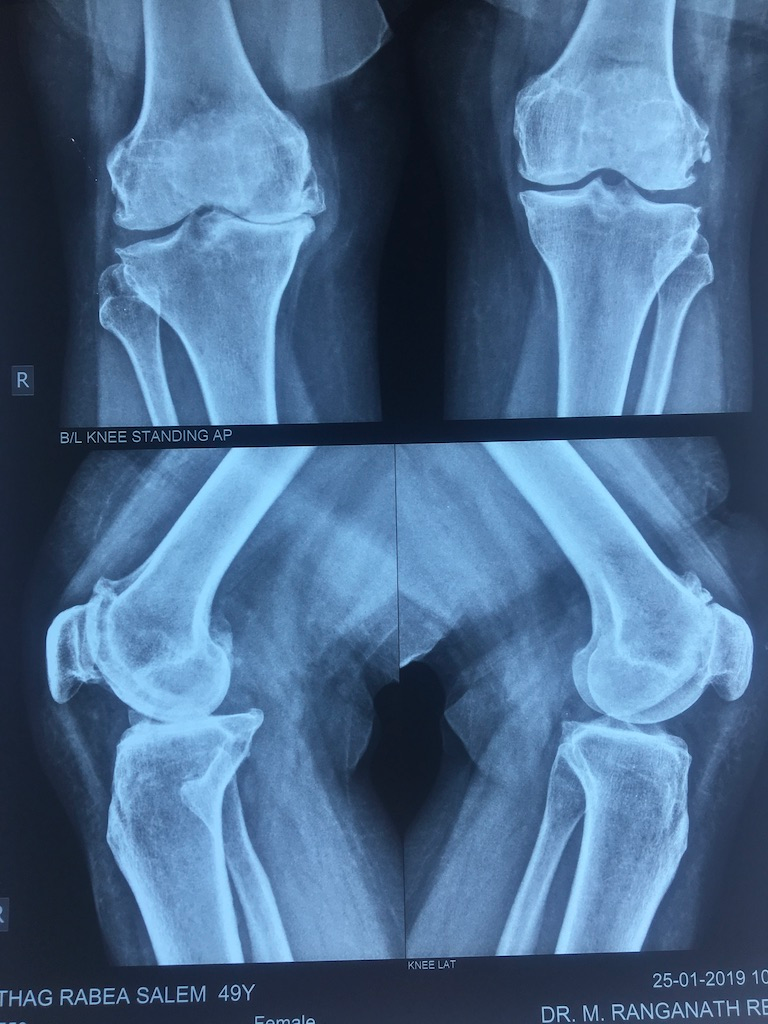 Pre-operative X-ray
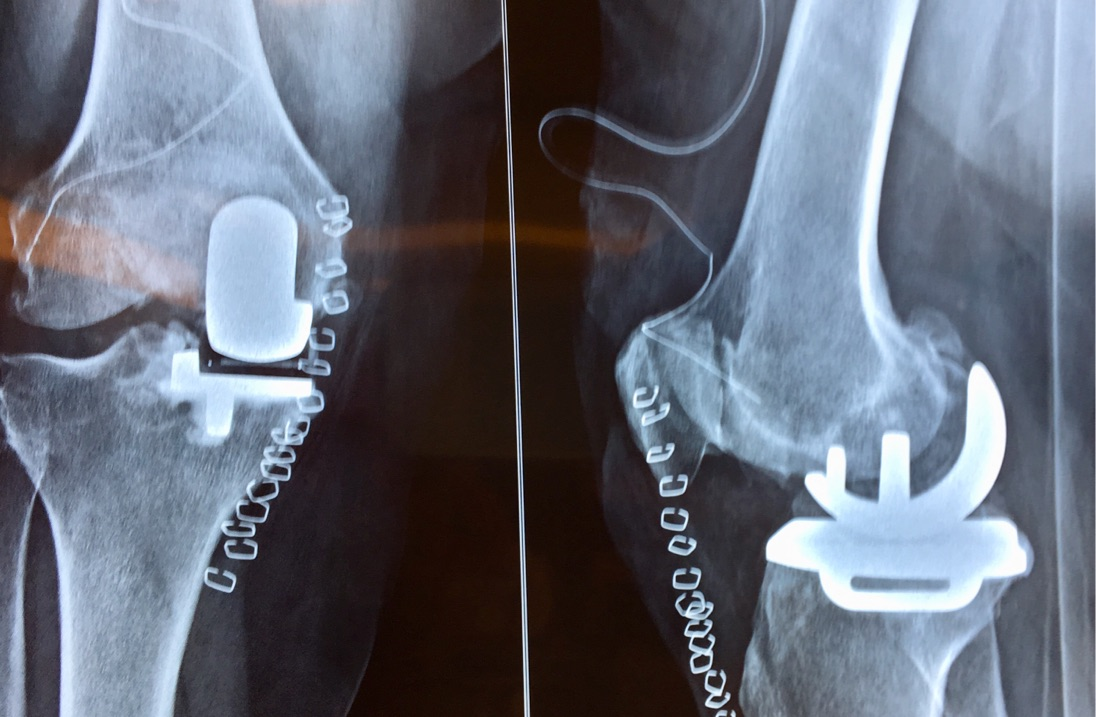 Post-operative X-ray
Why the Distinction Matters in Practice
Because less of the joint is altered, the procedure carries real, measurable advantages over total replacement for the right candidate: a smaller incision (roughly 3–4 inches compared to 7–8 inches), less blood loss, a lower risk of infection and blood clots, and a meaningfully faster recovery.
Hospitalization may often be 1–2 days instead of 3–5, with many patients walking unassisted within one to two weeks rather than one to three months.
Because the ligaments are preserved, the joint tends to feel more naturally "like your own knee" afterward, which is a common patient-reported difference compared with total replacement.
What the Evidence Actually Shows
When you analyze the data spanning the 10- to 25-year mark, the outcomes are quite strong. Patients who have undergone partial knee replacements have reported exceptional functional outcomes — such as shorter hospital stays, fewer post-operative complications, and returning to work in a short time.
In multiple studies cited by the American Academy of Orthopedics (AAO), the success rates exceeded more than 90% at the 10-year mark.
Who Are the Ideal Candidates for Partial Knee Replacement?
The following criteria make a person ideal for a partial knee replacement surgery:
Knee Pain in a Limited Area
Pain is mainly localized to a particular area of the knee.
Arthritis in a Single Compartment
Arthritis is confined primarily to one compartment of the knee.
Limited Range of Motion
Knee movement has become restricted because of the affected compartment.
Failure of Conservative Treatment
Less invasive treatments have been tried without providing lasting relief.
Who Isn't an Ideal Candidate for UKA?
Partial knee replacement is only for selected patients — not for all. Patients who have extensive arthritis in multiple compartments of the knee or significant knee joint deformity are not suitable for UKA.
Similarly, cases with torn ligaments such as the ACL or PCL, severe rheumatoid arthritis, or inflammatory arthritis are also not suitable for UKA.
Recovery: What to Realistically Expect
Partial knee replacement provides faster recovery time, as many patients walk within a few days after surgery with minimal assistance.
Patients regain range of motion with focused physical therapy that strengthens the muscles supporting the joint.
When compared to a total knee replacement, complete recovery may happen after 8 to 10 weeks. The recovery can be much faster than the months-long recovery associated with a total knee replacement.
Benefits of Partial Knee Replacement
Patients who are eligible for a partial knee replacement can have the following advantages:
Shorter duration of the procedure
The procedure is minimally invasive
Less painful recovery period
Decreased blood loss
Faster recovery
Resumption of work in a short time
Is Partial Knee Replacement Right for You?
A partial knee replacement is not a one-size-fits-all solution — it is rather a less extensive version of a total knee replacement.
For patients with intact ligaments, isolated compartmental arthritis, and a relatively healthy knee joint, the procedure yields favorable long-term outcomes and faster recovery.
A majority of patients feel natural and are satisfied with partial knee replacement.
